Buy anything from 5,000+ international stores. One checkout price. No surprise fees. Join 2M+ shoppers on Desertcart.
Desertcart purchases this item on your behalf and handles shipping, customs, and support to UK.
⚡ Power up your monitoring game — stay ahead, stay informed!
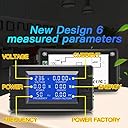
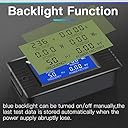
The MORNING GROUP PZEM-022 is a versatile AC panel meter featuring a split core current transformer for easy installation. It accurately measures voltage (80-260V), current (up to 100A), active power, energy consumption, frequency, and power factor simultaneously. Equipped with a large blue-backlit LCD, overload alarm, and automatic data storage, it ensures real-time monitoring and reliable alerts to prevent energy waste or equipment damage. Ideal for professionals seeking precise, continuous power diagnostics with user-friendly controls.


| ASIN | B07JB9B2QL |
| Best Sellers Rank | #21,836 in Tools & Home Improvement ( See Top 100 in Tools & Home Improvement ) #33 in Multi Testers |
| Brand | MORNING GROUP |
| Brand Name | MORNING GROUP |
| Color | Black |
| Compatible Devices | Standard AC Electrical Circuits (80-260V, 100A) |
| Customer Reviews | 4.4 out of 5 stars 2,523 Reviews |
| Item Dimensions | 3.42 x 0.95 x 1.85 inches |
| Item Weight | 0.16 Kilograms |
| Item dimensions L x W x H | 3.42 x 0.95 x 1.85 inches |
| Manufacturer | Wenzhou Morning Electronics Co., LTD |
| Measurement Type | Ammeter, Multimeter, Voltmeter |
| Minimum Operating Voltage | 80 |
| Model | PZEM-022 |
| Part Number | ekspqcmdyw1126t |
| Power Source | Corded Electric |
| Style | 1 Piece AC 100A Meter(Split Core Transformer) |
| Style Name | 1 Piece AC 100A Meter(Split Core Transformer) |
| UPC | 703931915688 |
| Unit Count | 1 Count |
3**O
NOT made in the USA, runs off 240Vac just fine
The current most helpful review says "Made in USA" when clearly these meters are not, these meters are made in China. Also, they do not HAVE to run off of 120Vac, they will run off 80-260V. With those corrections out of the way, these meters work well. This meter helped me identify a serious problem with a 5-ton Trane heatpump unit. And no, it's not hard to stop a Trane, all you need is a faulty low pressure sensor switch and it will not only stop but also start running backwards in mere milliseconds. Be advised these meters alarm on Power only. I knew what they did when I bought them, I only wish they had a version that could be set to alarm on voltage or current or all three via independent settings. It would be nice if there was an audible alarm of some sort. I also wish they had a mounting box or panel with an appropriate cutout. (product improvement suggestions) Line voltage varies and so therefore current draw will also vary and therefore Power varies (voltage times current). In my scenario I have a 5-ton Trane heatpump unit whose compressor liked to run backwards. If your heatpump sounds louder than normal or hits like a sledge hammer while running, it's running backwards. Contrary to popular belief, running backwards did not harm the motor nor the scroll compressor that the motor drives (this unit is 11 years old). However, it does eat a lot of energy for no gain. This needleslly increases the electric bill considerably. It is also interesting that when running backwards, the compressor (I put the meter in the heatpump on the leads running into the compressor) draws more current and therefore has more power consumption. When running correctly, this compressor draws 16.6 Amps at 234.9V as measured. When running backwards it draws 21.9 Amps at 235.7V as measured. That is a 32.5% increase in current and therefore power for no gain (ie no heating or cooling inside the house = total wasted energy). Once I knew that, then I needed a permanent means with alarm and real time display inside the house. That's where these meters saved the day. It is also interesting to note that the impulse from forward to reverse draws a very short (milliseconds) 100 Amp spike. I was curious, so I recorded this with a data logger that I also got here from Amazon, namely the Supco LCV LOGiT Current and Voltage Data Logger (1s minimum data interval was sufficient to catch it twice out of 4 times), and I saw it instantly on an oscilloscope also bought here on Amazon, namely the Owon SSO8192. These power meters are great to give a real time, portable and inexpensive current, voltage and power reading but are not usefull for capturing fast spikes like the more expensive equipment. What was causing this reversal was a defective low pressure switch on the unit. This switch would let the 24V contactor coil voltage drop intermittantly, and for less than a millisecond. The resulting sound has a BANG loud enough to shake the 4,000 sqft house (through the vent system) followed immediately by a louder running compressor as it starts running backwards (like it was digging deeper). From forward to reverse in milliseconds with a 100A spike. BANG! By shorting the leads running to the low pressure switch, the unit now runs as normal, no idea what this has done to longevity. My theory as to why this Trane 5-ton scroll heatpump compressor draws more amps in reverse, is because the compressor must have an internal anti-backflow valve or device of some kind. With this meter I was able to temporarily monitor directly inside the outdoor unit and I can now permanently monitor the current draw from inside the house by connecting this meter to the breaker box lines running to the heatpump outside. I also have the alarm set to 5.3kW (240V times 22 Amps). The fans draw 4.7 Amps. 16.6+4.7=21.3A running correctly. In reverse that would be 22+4.7=26.7A. This way, I will have an exact alert if the heatpump ever tries to reverse again. No need for hearing accuity of the compressor. Note I wired this inside the breaker box, directly across the breaker feeding the heatpump unit with the current sense transformer on one of the wires. The permanent fix for the heatpump was to replace the low pressure switch (simply put a new one in line and abandoned the old). We also replaced the contactor as the contacts were severly damaged. I had the start capacitor and hard start unit replaced for piece of mind. I will leave this meter in place as I do not know if this same failure or another such as the high pressure switch will fail again in the future. I appreciate the peace of mind this meter with flashing screen alarm provides. Note, you can turn the LCD off by pressing the button and yes, on alarm it will still flash. It holds the LCD backlight setting (on or off) through a power outage AS WELL AS the power alarm setting. 2 minutes tested. It may hold these settings longer, I don't know. But for my purposes, that is more than long enough for the guardian 22kw to kick on and the transfer switch to automatically kick in during a power outage. For my purposes I don't care, but I also noted it did hold the kWh accumulation for two minutes as well. The leads on the CT transformers are relatively short (about 4-6 inches), I soldered on an additional 2 ft of tined multistrand 20 AWG silicone insulated (600V) wire to them. Solder station (Andolar 60W), solder (60/40 rosin core) and wire (Haerkn) were also bought right here on Amazon. I used electrical tape (3M Super 88) bought right here on Amazon to insulate the joints, you can use heat shrink tubing for a more professional look. At $15.30 apiece if you buy two, this is a very inexpensive troublshooting and monitoring tool. I hope this helps someone.
D**N
I loved this power meter so much, I bought two more!!
A few facts: * I am only talking about the "AC 100A Meter(Split Core Transformer)" style; the other 3 styles you can order from this page look dramatically different and no doubt have extremely different functionality, so don't rely on customer reviews or answers that do not specify which style they bought; also, it is probably a good idea to specify the style you are considering purchasing if you are asking a question on here. (Or not, you decide.) * You will have to supply your own leads to connect directly to the power source. The wires and alligator clips you see in the pictures are my own. * CONCLUSION: Don't. Assume. Anything. Ever. A few opinions: * NEGATIVE: This meter does not keep track of the amount of time that has passed since the watt-hours were reset, so you will have to mark down the time somehow if you intend to calculate daily/monthly energy costs. * POSITIVE: This meter survives power outages without losing track of watt-hours used, which every power meter should do and is a huge benefit in areas like mine where the power goes out frequently and I cannot monitor the power daily. * CONCLUSION: Just buy a couple of these and you'll be happy you did. * NOTE: I live in very rural Florida, USA--notice the electobraid in the pictures which implies that I have horses grazing in my front yard--so code violations and permits are basically non-existant. So, please don't leave comments regarding code violations from my pictures or assume that I was the person who made them. Also, please don't flame me because you assume to know my political persuasion: My family is divided politically and religiously (it would blow your mind if I explained it all), and we still get along super-well because we all love and respect one another, thank you very much. This posting is about electrons, not people. 220-volt measurements: * I saw conflicting answers regarding the measurement of 220-volt (or 240-volt... whatever, I get it) in places like the United States where there is a neutral wire that divides the voltage in half. My use case is a main panel that supplies power to a sub-panel in my workshop where some circuits are 110-volt and some are 220-volt. (NOTE: The voltage between the red and black wires is 220 volts, and the white wire is the neutral that is halfway in between. Thus, red to white is 110 volts and black to white is 110 volts, albeit at opposite phases but what the heck the appliances are stupid and don't really care about phases.) * I have 3 of these devices, so I am able to show my results in real time. Ignore the watt-hour numbers in my photos, because the meters were reset at different times. Pay attention only to the volts, amps, and watts. (I'll look it up later so I become a supposed expert, but right now I really do not understand what power factor even means. I am pretty smart and was literally at the top of my class in my 300-level college electronics course, so I know what I know and I know that I don't know everything.) * Everybody who answered the question about measuring 220 in this situation (at the time I read it) agreed that you should put the power leads on both ends (red and black) of the 220 circuit, so in all 3 samples the power leads stay in the same place. * Of course, if you have an appliance (like my air conditioner or my well pump) that only uses 220 and doesn't use the neutral line at all, you could simply span the red and black wires and ignore the white wire. But for subpanels where there is a mix of these appliances and circuits, this is not so simple. * Results when the coil was on the black side (and the #3 power leads were spanning the red and black): * #1 black-side meter (left): 120 V, 5.2 A, 585 W * #2 red-side meter (right): 122 V, 0.3 A, 22.5 W * #3 red/black meter (middle): 242 V, 0.3 A, 46.1 W * #1 PLUS #2 = 607.5 W, not 46.1 W!!! * Results when the coil was on the red side (and the #3 meter power leads were spanning the red and black): * #1 black-side meter (left): 120 V, 5.5 A, 615 W * #2 red-side meter (right): 122 V, 0.3 A, 22.5 W\ * #3 red/black meter (middle): 242 V, 5.6 A, 1.25 kW * #1 plus #2 = 637.5 W, not 1.25 kW!!! (OMG, Becky!) * Results when the coil was on the white side (and the #3 meter power leads were spanning the red and black)... what the heck, this sort of answers the question of whether current flows on the neutral or not (SPOILER ALERT, it does, why else would it be made of copper): * #1 black-side meter (left): 121 V, 5.3 A, 593(5?, thanks Siri!!!) W * #2 red-side meter (right): 122 V, 0.3 A, 22.6 W * #3 red/black meter (middle): 243 V, 5.1 A, 1.16 kW * #1 plus #2 = 617.6 W, not 1.16 kW!!! * CONCLUSION: It is unpossible to accurately measure a split voltage system with a single meter. If you put the coil on one end (black) or the other (red) you will get the correct amperage for that side but it will inaccurately multiply that by the total voltage and overstate the watts. If you put the coil in the middle, you will get the larger of the two amperages from either side multiplied by the total voltage and (IMO) overstate the watts (maybe?). * QUESTION: My dad always told me you "pay" for the other side even if you're not using it, so you should balance out the 110-volt circuits as much as you can to maximize your cost. Is that true? * OBVIOUS CONCLUSION: I have gone to all the trouble of buying 3 units and giving you all of the facts (backed by photos), so you should not give me a thumbs down even if you completely disagree with anything I have said. You should give me a huge thumbs-up and politely state your disagreements with me to make yourself feel better, look smart to everyone else, and actually educate me in the process. Thanks, and G-d bless.
A**Y
Breaks easy, have to figure it out, difficult mounting
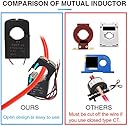
The pros: Love the blue backlighting Fairly accurate to the P=IV calc when the current is over 10A OK price The cons: Cheap plastic. The “hinge” on the current transformer (CT) is so thin it is barely reliable (mine broke almost instantly). If the CT cannot clamp tightly around the wire it is useless. Almost impossible to mount securely if you do not have a box to exactly fit it into (why no dog ears to screw down??) Short lead on the CT I wanted to see how much current my Prius Prime actually used when charging, so was excited to get this unit. It arrived pretty fast and was an OK price at $20. Considering all the info it provides I was OK with that cost. There are no written instructions on how to connect the CT part to the unit but there is a pretty good drawing on the back of the unit to show you which lugs to connect them to. You do have to also connect the unit to an AC power source and there is nothing included to do that. I used some wire and opted to connect it to a pig tail and plug into a wall socket as I did not want to try to connect it in circuit with the line I was charging the Prius on. I connected the CT around the HOT line in the breaker box and noted you really cannot easily snap shut the tab that is supposed to hold it. If the CT is not firmly closed it cannot get an accurate reading. My first try was less than half the proper values. While trying to adjust the hinge plastic on the CT broke, making it essentially useless unless you MacGyver it. I used some duct tape and a plastic wood clamp to securely fit the CT over the line and it started giving more proper readings. I cannot use it like that other than to test so the device is just a pile of plastic to me outside of a test like this. I owned it for all of 15 minutes before it became useless. With the MacGyver clamp in place, I got the following readings on the device. With minimal load on the circuit (fluorescent lights) the device read 2.43A, 123V and indicated 295W. I forgot to note the PF value. P=IV indicates the Watts should be 298.89 so the unit was off a few watts. The PF value may have closed that gap a bit there. I used a Commercial Electric ammeter to check the amp rating and it indicated 2.38A so at least one of those is off a tad. Connecting the Prius charger and starting the charge the readings became: 13.87A, 124V, 1.70kW. I think the PF fluctuated between .99 and 1.00, which means it would not make much of any impact on the final calculation. P=IV means the watts should have been 1.72kW, making it only off by around 0.02 at that higher load. Not bad in my thinking. My Commercial Electric meter indicated an Amp reading of 14.10A, so again the two devices are off by a bit. I strongly dislike the mount options. It is designed to slot into a rectangular hole with some small plastic tabs to hold it in. That means you have to engineer something like that. There are no other options on the device to mount it – no dog ears to apply a screw, nothing. Forget trying to wall mount it unless you build a rack to insert it into or MacGyver a mounting solution. Frustrating. The CT is on a very small lead. For bench work that is probably not a big deal but if you want to connect this to your breaker box to get real time readings that lead is too small. Since mine broke anyway I soldered in a longer lead line so I could connect into the box and set it on a shelf I had to quickly make. In short the device is pretty cool with what it displays for you, and seems to be fairly accurate at higher Amperage loads. Someone on here indicated it did not read above 5A but that is incorrect if you buy the 100A version, which I did (there is a 5A version which will limit you to only 5A or less). The problem is the CT is too cheaply made for the secure clamping it needs to have; if the CT is not securely connecting to itself (you’ll understand when you look at it) then it cannot read properly. Before I MacGyver’d it I would change the Amp value by almost 2A by squeezing the CT. My plastic wood clamp fixed that. But the design is not endearing to a long useful life for the device. If the manufacturer bolstered the CT hinge and clamp tab, and provided some dog ears so you can wall mount it, this would be a five star tool out of the box. No idea yet how long it will last.
T**H
Great unit for "remote" current monitoring
This is just a great and accurate current meter with a most unusual characteristic: the current sensing dongle can be placed at least 10 feet away from the display module. Now I had to extend the dongle's little 6" length wire pair but that was quite easy and adding 10' of wire to this sensing unit did not degrade its ability to produce accurate measurement (see my pic that compares reading with a traditional clamp on amp meter). The only draw back is that the display modules must be powered (as it is designed to be wired to the AC appliance under test. I just wanted to use it to remotely measure the current being drawn by a misbehaving induction stovetop).
E**.
Great meter to monitor generator performance
Installed these meters at the breaker box when I installed a circuit for a portable back-up generator. The meters were small enough the I managed to fit them both into a double gang box attached directly to the breaker panel. One meter was attached to each 110V leg from the generator. When the generator is on, the meters show the draw on each leg. This allows me to balance the load on the generator and to make sure that I don't exceed the maximum output of the generator. The meters tell me the power frequency so I can make sure the THD stays low and will not damage sensitive electronic equipment. The meters installed easily even though the directions weren't great. The display is easy to read and bright enough to see in a lighted room or in the dark.
K**M
Amazing power display meter
Really nice, these meters display a lot of data that I appreciate having. Amazing for being such a compact package. Very very nice.
A**O
Good device; poor connectivity
Pros: - The device itself works fine. Has a 100amp capacity and a display to show real time consumption in different units. Due to the poor connectivity (see Cons below) the consumption display is really the only reliable functionality. - Had an electrician install it because I'm not an expert. He said the installation was easy, didn't seem to make much effort. Cons: - The device has to be next to the internet router, otherwise it losses connectivity. Mine is several feet away and will disconnect after 1 hour or so. - It has to be reset when it losses connectivity, which is not a straightforward process. In my case I decided to rely on the usage meter in the device and disregard the online functionality just to not have to reconnect it each time. - It uses the Tuya Smart app, which seems to be a generic IoT aggregator for devices from different manufacturers. It's a one-size-fits-all so obviously it will not be tailored to your specific device. In the case of this meter, I wish it could show Amp readings and that the pairing process was easier.
V**Y
Works good
Semi easy to hook up. works great.
V**E
Funciona par 2 fases de 120V
Al contratio de lo que dice el vendedor SI funciona par medir 2 fases de 120v cada una en 240v. En este caso hay que alimentar el medidor con las 2 fases (no conectar el neutro) para tener la lectura en 240v y colocar las 2 fases a dentro de la dona y el medidor da lectura de la energia total... Perfecto par medir la carga de un generador 120/240 que utilizamos como respaldo por apagones y temporada de huracan...
L**7
Très bien fait !
Facile à connecter, et semble très précis.
A**R
The voltage is spot on, unlike so many other similar devices I have tried.
Great quality. The voltage is spot on, unlike so many other similar devices I have tried.
R**7
Accurate measurements
Easy to use and electrical usage measurement seems accurate.
S**L
Solicito el software.
No tengo el software para ver datos. Ya intenté descargar varios pero ninguno funciona. Tengo Windows 10. Me puede compartir un link para descargar el software. De antemano muchas gracias.
Trustpilot
2 days ago
2 weeks ago