Desertcart purchases this item on your behalf and handles shipping, customs, and support to UK.
💡 Stay dry, print sharp, and never miss a layer!
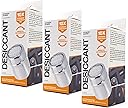
Slice Engineering’s Filament Drying Desiccant (6 Pack) uses activated alumina to absorb moisture 10 times more effectively than silica gel, reducing filament humidity to near 0%. Infinitely rechargeable and designed to fit perfectly inside filament spools, it prevents common print defects caused by wet filament. Compatible with all FDM materials and spool sizes, this USA-made solution ensures superior print quality and long-term filament preservation.


| ASIN | B0DD2B6C52 |
| Additional Features | 10x more powerful moisture absorption, near 0% humidity, infinitely rechargeable, universal compatibility |
| Best Sellers Rank | #32,546 in Industrial & Scientific ( See Top 100 in Industrial & Scientific ) #98 in Desiccants #603 in 3D Printing Filament |
| Brand | Slice Engineering |
| Brand Name | Slice Engineering |
| Color | White |
| Customer Reviews | 4.2 out of 5 stars 22 Reviews |
| Item Diameter | 49 millimeters |
| Manufacturer | Slice Engineering |
| Manufacturer Part Number | P-FDD-AC-1111-6P |
| Material | activated alumina desiccant |
| Material Type | activated alumina desiccant |
| Model Number | P-FDD-AC-1111-6P |
| Number of Items | 6 |
| Special Feature | 10x more powerful moisture absorption, near 0% humidity, infinitely rechargeable, universal compatibility Special Feature 10x more powerful moisture absorption, near 0% humidity, infinitely rechargeable, universal compatibility See more |
| UPC | 850063808200 |
| Unit Count | 6 Count |
| Warranty Description | No warranty |
B**Y
worth it
I've been using these for a while now in my Bambu AMS. They keep the humidity below 10%. I recharge them every time I replace a spool. I recharge them in my air fryer at 400F for 2 hours. I verified that they were recharging by weighing the canisters before and after recharging. BUT - be sure you read the directions and remove the plastic cap by turning it CLOCKWISE - otherwise you'll never get all the little desiccant balls up off your floor!
J**L
No Humidity
Works great. Humidity less than 10% in my Bambu Lab P1S AMS using desiccant holders. I just wish it was easier to handle!
J**S
At this price, it needed to work as advertised
This is my first desiccant, so I'm not sure if others are any better at keeping filament dry, but this one definitely didn't live up to the hype and for this price it needed to work as advertised. The lids: ugh, the lids come of soooooo easy that if you even drop these on the floor the "threads" unscrew and it's everywhere. And you are NOT going to remember they're in the middle of the filament spool when you take it out of the dryer, so you ARE going to drop them frequently. The dryness: this is my first desiccant, but these were not keeping my creality space pi dry. It's my first dryer too so maybe it's operator error, but I don't think so. I tried cooking these desiccants per instructions to "recharge" them, but that didn't help. The desiccant comes with a little color strip that's supposed to tell you humidity (I think?), but it just stayed the same color whether it was in the dry box or out in the 50% humidity air, so I don't think that thing works either. I'd probably keep it if it weren't so expensive, but at this point I just think it's a junk product. At this price, it should have been a no-brainer that it works, but instead I can't tell if it works at all. I suspect it's a design flaw to have such a small opening into the can for moisture to get in, thus most of the desiccant is dry but is hidden behind the wet desiccant that's closer to the window? I have no idea what's dry and what isn't since this stuff doesn't change color when it moistens, but it's remarkable how little effect this has on the moisture level in the chamber (as reported by the chamber's built-in humidity sensors).
D**N
Very nice and convenient, but a bit pricy.
Overall these are very nice and I'd probably buy more if they cost less. These have a plastic cap that can be used to seal off the desiccant from the air when not in use. On one of the cans, I struggled to remove this. I ended up having to cut it off - that was a pain. These plastic lids are a good idea, but they should be a little easier to take off. Also, 5 of the cans were filled to the very top, but the sixth can was only about 90% full. I did not see any fines or powder that could otherwise contaminate the filament. These desiccant cans have been placed into separate plastic boxes with dried 3D print filament which also include digital humidity sensors. The humidity has dropped from about 35 to 20% in each box within about two days of being closed (I think 20% is the lowest my "cheap" humidity sensors will report). The all metal design is nice because these can be placed into an oven and regenerated without having to empty and then refill the container with dried desiccant. Nonetheless, I'll probably 3D print my own plastic containers, purchase 2 lbs of desiccant and fill them myself next time to save some $.
E**G
Too small for Bambu Spools.
Humidity control is great. Falls out of Bambu Lab spools. Way too small.
A**E
Idea has merit but . . . .
The idea is a good one. But there is no way to know when the desiccant needs regeneration and it when it does, it will be a pain. The cannister is a bit thin and its threaded top fits poorly. The desiccant media/balls inside need to be removed when regenerating them. The balls are a pain to remove and put back into the cannister. A very pricey experiment on my part. You will need to print adapters to fit these in the center of a filament roll. There are no standards on the dimensions of filament rolls.
M**V
For 3D printer filaments, silica gel is probably a much better solution for you.
I tested these side-by-side with silica gel, and they performed similarly (in a sealed 5L container with six freshly recharged cans, both dropped RH from 35% to <10% within a few hours). But Silica gel is far easier to recharge (250F for silica vs 450F for alumina), and silica gel can be recharged while inside 3D-printed spool adapters (assuming you use a high temperature filament like PA6-GF). Their ‘white paper’ places these alumina cans in a vacuum-sealed bag, which isn’t exactly a tough environment for these things to perform in. It’s possible that activated alumina has more absorption capacity than silica gel, but slice engineering makes no such claims as far as I can tell, and I couldn’t find any such information on the Internet. Seems like fake science to support marketing hype.
Trustpilot
5 days ago
1 month ago