Desertcart purchases this item on your behalf and handles shipping, customs, and support to UK.
🚀 Tiny Board, Giant Possibilities — Power Your Next Innovation!
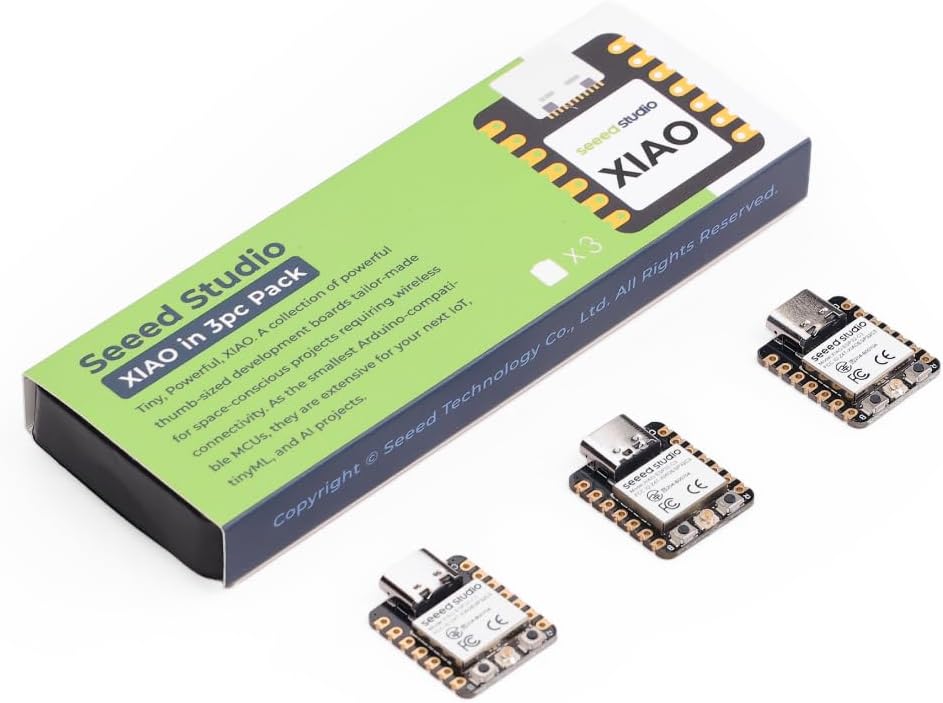
The XIAO ESP32C3 is a compact 3-pack of ultra-efficient RISC-V microcontroller boards featuring 160 MHz CPU speed, integrated Wi-Fi and Bluetooth 5.0 with 100m+ range, and advanced power management supporting lithium battery charging. Compatible with popular development platforms like Arduino IDE and MicroPython, it’s designed for professional makers and IoT innovators seeking a powerful, space-saving solution with proven reliability.


| ASIN | B0DGX3LSC7 |
| Best Sellers Rank | #1 in Single Board Computers (Computers & Accessories) |
| Brand | seeed studio |
| Built-In Media | / |
| Compatible Devices | Arduino IDE, MicroPython, CircuitPython, PlatformIO, ESP IDF, Zephyr, Matter, ESPNow, Meshtastic, WLED, ESPHome, Home Assistant, Ubidots |
| Connectivity Technology | Wi-Fi, Bluetooth 5.0 |
| Customer Reviews | 4.8 out of 5 stars 73 Reviews |
| Included Components | / |
| Manufacturer | seeed studio |
| Model Name | XIAO ESP32C3 |
| Operating System | Arduino IDE, MicroPython, CircuitPython, PlatformIO, ESP IDF, Zephyr, Matter, ESPNow, Meshtastic, WLED, ESPHome, Home Assistant, Ubidots Operating System Arduino IDE, MicroPython, CircuitPython, PlatformIO, ESP IDF, Zephyr, Matter, ESPNow, Meshtastic, WLED, ESPHome, Home Assistant, Ubidots See more |
| Processor Count | 1 |
| RAM Memory Installed | 0.4 MB |
| RAM Memory Technology | DDR |
| Ram Memory Installed Size | 0.4 MB |
| Unit Count | 3 Count |
| Warranty Description | 2 year |
| Wireless Compability | 802.11ac |
P**N
Good product…Reviewed by a hands-on home automator
I picked up this three-pack to prototype some home automation projects, and I’ve been consistently impressed with how much capability Seeed Studio has packed into something roughly the size of a thumb drive. The Hardware The ESP32C3 is built on a RISC-V core running at 160MHz, which is a refreshing departure from the Xtensa architecture of older ESP chips. In practice it handles Wi-Fi and BLE tasks without breaking a sweat. The form factor is genuinely tiny — it fits on a breadboard with pins to spare — yet it still manages to expose 11 GPIO pins, hardware UART/I2C/SPI, and a decent ADC. There’s even an onboard ceramic antenna and a u.FL connector if you need external range. For my two builds, that onboard antenna was more than adequate throughout the house. Real-World Projects I put two of the three boards to work immediately. The first became a water softener salt monitor using an ultrasonic distance sensor to track the salt level in the brine tank. The ESP32C3 reads the sensor, does a little math, and pushes the level to Home Assistant via MQTT over Wi-Fi. It wakes, reads, reports, and goes back to deep sleep — all in a few seconds. Battery life on a small LiPo has been excellent. The second board is a freezer monitor watching for temperature excursions with a DS18B20 probe. It alerts me if the door is accidentally left ajar or if something goes wrong. Both projects came together quickly thanks to the board’s compatibility with the Arduino IDE and ESP-IDF, and the wealth of community libraries already targeting the ESP32 family. Value At roughly $5–6 per board when bought as a three-pack, these are hard to beat. You get USB-C, a built-in battery charge circuit (great for portable/sleep-based builds), and solid documentation from Seeed. Competing options at this price point often sacrifice one of those three things. Minor Gripes The pads are small, and fine soldering is required if you want to attach wires directly rather than using header pins. Beginners might find the initial toolchain setup slightly fiddly, though Seeed’s wiki covers it well. Also, the onboard LED is wired in a slightly non-obvious way compared to other boards — worth checking the pinout before debugging “why won’t my LED blink.” Bottom Line If you’re building IoT sensors, home automation nodes, or any low-power connected device, the XIAO ESP32C3 punches well above its price. The three-pack makes it easy to prototype, dedicate a board to a finished project, and still have a spare. Highly recommended for makers of any level.
A**S
Small and good value.
Great little board.
C**.
Highly recommended.
TL;DR You can't go wrong with XIAO ESP32C3. I never have any problems with these boards. I highly recommend them. PROS - Quality boards - Clear silk screening - Onboard battery charging (others don't have this) - Excellent documentation online CONS - There is no way to monitor battery life onboard, they need to add an analog pad for reading this
E**C
Amazing value and dead simple to use
Great little boards and incredible value for the money. Perfect for ESPHome. Dead bug it or solder onto a protoboard with the castellated pads. I didn’t realize it had a built-in battery circuit, have not messed around with that but I intend to try it out sometime. No temp wire makes me nervous though. Can’t get easier to program and flash than ESPHome builder- Claude code can just spit out the yaml you need and you’re up and running in seconds. Comes with little WiFi antennas but I actually found the reception isn’t too bad without it.
T**N
Well worth the money
Works very well for it's size and cost. Was able to build my own ESP32 Oil monitor which communicates via WIFI with home assistant. I've used a couple of different ESP32's and this one is my favorite. It's capability and size make it my go-to.
C**T
I wish i had discovered these sooner
I've become a big fan of Seeed Studios XIAO MCUs. I have very little to complain about. I've purchased the S3, C3, and C6 versions and they've all worked perfectly, not a dud in the bunch. All the XIAO's are the same size and have the same number of pins which I find convenient for the stuff I do. I wish I'd discovered these about a year ago.
B**R
Nice, Small Form Factor, WiFi & Bluetooth microprocessor
Thought I'd give these a try for a Low Power Battery Operated WiFi Project. They have 11 Inputs, 4 can be assigned for Analog Inputs, I2C Communications (as well as other Comm options) and Digital I/O. The Analog Inputs caught my attention as the Low Power Battery Operated System I was designing required at least 2 Analog Inputs, one for the Sensor and the other for monitoring Battery Voltage. (The WEMOS R1 Di Mini has only one Analog Input). The Breadboard design worked very well, however I was able to locate I2C Communication Sensors that eliminated the need for Analog Inputs. Therefore, these units have been placed in my inventory awaiting a suitable application. Pros: 1-Appear to be well built 2-Small Form factor 3-Low Power Settings available 4-Built-in Li-Ion 18650 Battery Charger with Protection Circuit (I have not tested as yet) 5-External Antenna allows easy placement in enclosure 6-Fast Processor Clock 7- Built-in WiFi & Bluetooth 8-Check "seeed studio" ESP32C3 Datasheet for full details Cons: 1-The external WiFi Antenna could also be considered a negative, depending upon application.
D**N
Cheap and cool
Pretty cool. I'm still figuring out what all I can do. AI goes in circles with them
P**S
Missing items
I received missing 1 out of the 3 boards
M**H
Bei Amazon zu teuer und umständlich
Super Produkt, aber bei Amazon viel zu teuer mit viel zu langer Versandzeit. Man bekommt das Produkt für weniger als die Hälfte mit deutlich geringerer Lieferzeit aus deutschem Lager beim Hersteller selbst.
Trustpilot
1 week ago
1 month ago