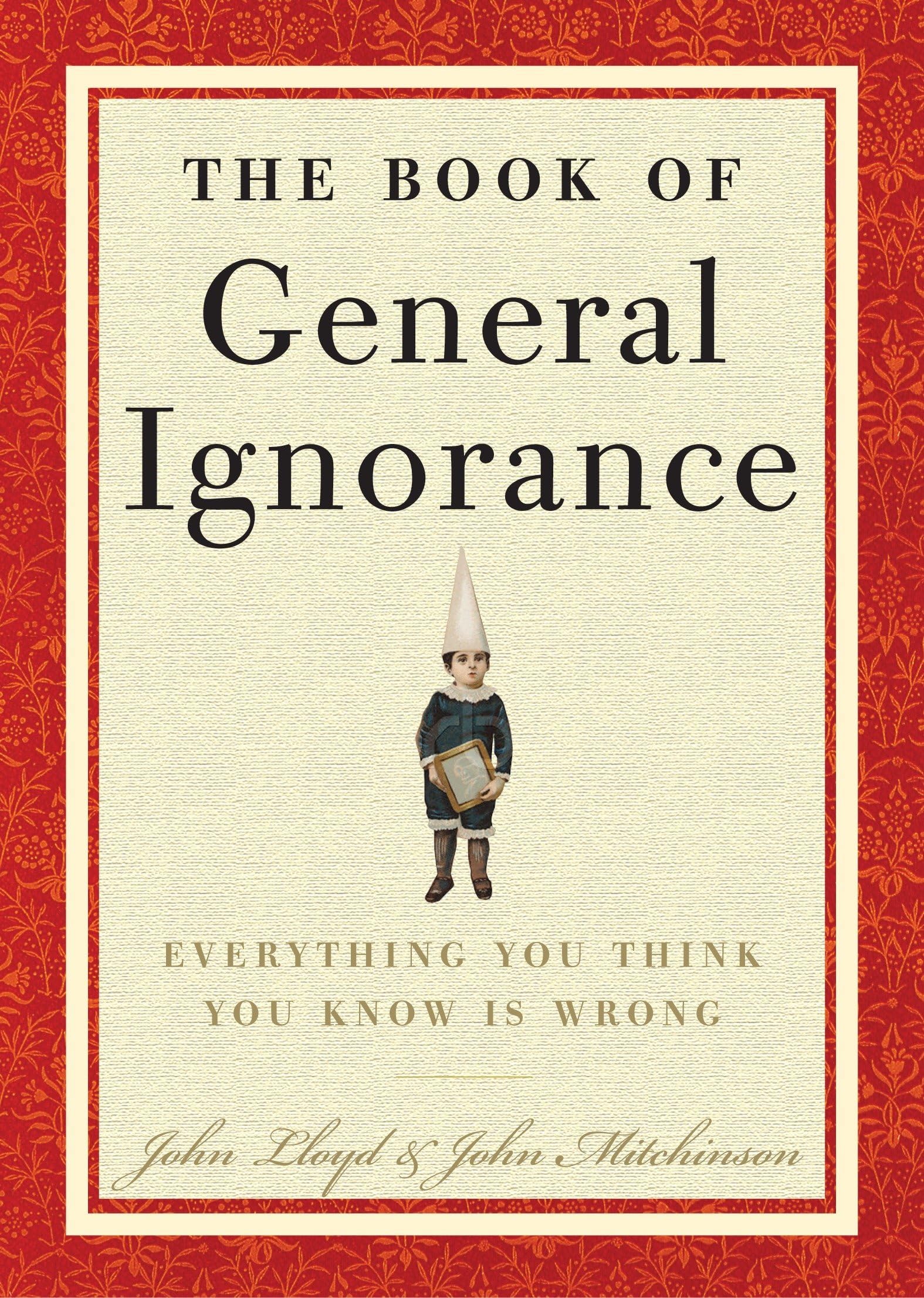
The Book of General Ignorance
Product ID: 4607256
Desertcart purchases this item on your behalf and handles shipping, customs, and support to UK.
NEW YORK TIMES BESTSELLER • A shockingly counterintuitive book of trivia that cuts through the misconceptions that most of us call “facts” to show how wrong we are about . . . well, everything. “Trivia buffs and know-it-alls alike will exult to find so much repeatable wisdom gathered in one place.”— The New York Times Think Magellan was the first man to circumnavigate the globe, baseball was invented in America, Henry VIII had six wives, Mount Everest is the tallest mountain? Wrong, wrong, wrong, and wrong again. Challenging commonly held assumptions in areas like history, literature, science, nature, and more, The Book of General Ignorance is a witty “gotcha” compendium of verifiably true answers to seemingly easy questions, like: Who was the first American president? Peyton Randolph. How long can a chicken live without its head? About two years. How many legs does a centipede have? Not a hundred. How many toes does a two-toed sloth have? It’s either six or eight. Check out The Book of General Ignorance for fun entries and complete answers to these and many more questions. You’ll be surprised at how much you don’t know! Review: You may be more ignorant than you know . . . but don't worry, so is everyone else. - At last, the American release of what is undoubtedly one of the most fascinating books you could ever hope to delve into! Whereas most trivia books contain "facts" of dubious origin and little consequence, it's clear that the authors of this book have gone through great pains to dig out and verify the most interesting tidbits from the realms of history, nature, science, and culture. Let's go for a few examples (edited heavily for space; the book is far more detailed). Q: How many words do Eskimos have for snow? A: Actually, no more than four. Although it's often said that Eskimos have dozens or even hundreds of words for snow, there are at most only four root-words for it, and that's drawing from all Eskimo languages. (They do, however, have more than thirty words for demonstrative pronouns, where speakers of English only have four.) Q: Who invented the telephone? A: Contrary to what you've been taught, it was not the famous A. Graham Bell! Credit goes to Antonio Meucci, a brilliant but ailing Italian inventor, whose patent fell into the hands of Bell, a young Scottish engineer. Meucci died before his case against Bell could come to fruition. There are hundreds of more questions to the end of fascinating and delighting the reader. However much you think you know, there will be mountains of information in here to surprise you--and that's quite the point. In the words of co-writer John Lloyd, "This book is for the people who know they don't know very much." As the authors hope you will come to understand, one's best hope in life is to recognize that one is generally ignorant, for it is simply impossible to know any but a sliver of the wealth of knowledge contained in and about the world. By admitting this, one is then motivated to ask questions that matter, for everything can be interesting when looked at in the right way . . . it's just that most people fail to look. But it goes further than that. "The Book of General Ignorance" is just one piece of a cultural phenomenon that has its roots in Britain. It was originally written as a textual accompaniment to the hugely-popular television show "QI", which operates under the philosophy that curiosity--for its own sake--is worthwhile. The show is unlike anything broadcast on American screens, featuring panelists who try desperately to claw their way to the answers to questions they are posed (questions not unlike those appearing in the book). While they're rarely correct from the off, it's the mere delight in discovering the truth that ends up being, unfailingly, uproariously funny. The show's a joyful celebration of the fact that questioning the world around us need not be an impenetrably erudite or boring endeavor. [...] In the meantime, pick up this book, and once you've been thoroughly impressed, buy it for your friends as well. It'd make a lovely gift for birthdays and the holiday season, assured to please scholar and dilettante alike. Recommended with cherries on top. Review: Non-Trivial Trivia for the Lover of all Things Factual - For the dedicated informavore, cracking the first page of this book is like ushering a person with a drinking problem into an Oktoberfest celebration. Consisting of over two hundred questions that many people THINK they know the answer to, The Book of General Ignorance proceeds to deflate the readers' pride in their own knowledge with both dispatch and humor. With queries ranging from "What human artifacts can be seen from the moon?" to "What would you use to overpower a crocodile?", the authors cover topics ranging from astrophysics to particle physics, from the sex lives of earwigs to the homicidal habits of hippos, all in clear and humorous prose. It would be tempting to look at this book as simply a larger and more explicit version of picking up a box of Trivial Pursuit cards and going through them one by one. And if you're someone that has actually done this (Sadly....I'm one of those people), you'll love this book. For many readers, delightful as the tidbits provided are, it will leave one with the odd and unfulfilling feeling one gets when one goes to a party, not having had dinner, and all that is available is a vast array of tasty appetizers: one gets stuffed, but keeps vaguely missing the main meal. That said, there is a takeaway message or two that have lasting substance. The first message from author John Lloyd, who quotes from the man who DIDN'T invent the light bulb (Thomas Edison) "We don't know a millionth of one percent about anything." Secondly, Lloyd feels that in addition to drives for food, shelter, and sex, mankind has a fourth drive: curiosity. And we should indulge this drive. Lastly, much that we think we know, we are in error about. The book, in a funky and funny way, is a call to humility, a call to lay aside pomposity, cockiness, and fear, the better to take off whatever lenses we have been gazing at the world through and to take a fresh look at information that is often staring us in the face. Information that just might push back the shoreline of ignorance just a few feet. As narrow as that newly uncovered beachfront might be, it is bound to hold fascinating clues to what is under that ocean of ignorance that we humans so badly want to explore.
| Best Sellers Rank | #112,965 in Books ( See Top 100 in Books ) #33 in Humor Encyclopedias #97 in Trivia & Fun Facts (Books) #110 in Quizzes (Books) |
| Customer Reviews | 4.3 out of 5 stars 1,827 Reviews |
S**K
You may be more ignorant than you know . . . but don't worry, so is everyone else.
At last, the American release of what is undoubtedly one of the most fascinating books you could ever hope to delve into! Whereas most trivia books contain "facts" of dubious origin and little consequence, it's clear that the authors of this book have gone through great pains to dig out and verify the most interesting tidbits from the realms of history, nature, science, and culture. Let's go for a few examples (edited heavily for space; the book is far more detailed). Q: How many words do Eskimos have for snow? A: Actually, no more than four. Although it's often said that Eskimos have dozens or even hundreds of words for snow, there are at most only four root-words for it, and that's drawing from all Eskimo languages. (They do, however, have more than thirty words for demonstrative pronouns, where speakers of English only have four.) Q: Who invented the telephone? A: Contrary to what you've been taught, it was not the famous A. Graham Bell! Credit goes to Antonio Meucci, a brilliant but ailing Italian inventor, whose patent fell into the hands of Bell, a young Scottish engineer. Meucci died before his case against Bell could come to fruition. There are hundreds of more questions to the end of fascinating and delighting the reader. However much you think you know, there will be mountains of information in here to surprise you--and that's quite the point. In the words of co-writer John Lloyd, "This book is for the people who know they don't know very much." As the authors hope you will come to understand, one's best hope in life is to recognize that one is generally ignorant, for it is simply impossible to know any but a sliver of the wealth of knowledge contained in and about the world. By admitting this, one is then motivated to ask questions that matter, for everything can be interesting when looked at in the right way . . . it's just that most people fail to look. But it goes further than that. "The Book of General Ignorance" is just one piece of a cultural phenomenon that has its roots in Britain. It was originally written as a textual accompaniment to the hugely-popular television show "QI", which operates under the philosophy that curiosity--for its own sake--is worthwhile. The show is unlike anything broadcast on American screens, featuring panelists who try desperately to claw their way to the answers to questions they are posed (questions not unlike those appearing in the book). While they're rarely correct from the off, it's the mere delight in discovering the truth that ends up being, unfailingly, uproariously funny. The show's a joyful celebration of the fact that questioning the world around us need not be an impenetrably erudite or boring endeavor. [...] In the meantime, pick up this book, and once you've been thoroughly impressed, buy it for your friends as well. It'd make a lovely gift for birthdays and the holiday season, assured to please scholar and dilettante alike. Recommended with cherries on top.
S**K
Non-Trivial Trivia for the Lover of all Things Factual
For the dedicated informavore, cracking the first page of this book is like ushering a person with a drinking problem into an Oktoberfest celebration. Consisting of over two hundred questions that many people THINK they know the answer to, The Book of General Ignorance proceeds to deflate the readers' pride in their own knowledge with both dispatch and humor. With queries ranging from "What human artifacts can be seen from the moon?" to "What would you use to overpower a crocodile?", the authors cover topics ranging from astrophysics to particle physics, from the sex lives of earwigs to the homicidal habits of hippos, all in clear and humorous prose. It would be tempting to look at this book as simply a larger and more explicit version of picking up a box of Trivial Pursuit cards and going through them one by one. And if you're someone that has actually done this (Sadly....I'm one of those people), you'll love this book. For many readers, delightful as the tidbits provided are, it will leave one with the odd and unfulfilling feeling one gets when one goes to a party, not having had dinner, and all that is available is a vast array of tasty appetizers: one gets stuffed, but keeps vaguely missing the main meal. That said, there is a takeaway message or two that have lasting substance. The first message from author John Lloyd, who quotes from the man who DIDN'T invent the light bulb (Thomas Edison) "We don't know a millionth of one percent about anything." Secondly, Lloyd feels that in addition to drives for food, shelter, and sex, mankind has a fourth drive: curiosity. And we should indulge this drive. Lastly, much that we think we know, we are in error about. The book, in a funky and funny way, is a call to humility, a call to lay aside pomposity, cockiness, and fear, the better to take off whatever lenses we have been gazing at the world through and to take a fresh look at information that is often staring us in the face. Information that just might push back the shoreline of ignorance just a few feet. As narrow as that newly uncovered beachfront might be, it is bound to hold fascinating clues to what is under that ocean of ignorance that we humans so badly want to explore.
C**.
Fun
Everyone loved it.
B**N
Well researched and written but needs a table of content on the Kindle Edition
This is a fun book with a large amount of trivia written in an easy to digress way. The book's focus is on trying to bust myths, like Macro Polo supposed travels, or whether feminists actually burned their bras. However, a lot of sections digress into interesting and sometimes lengthy run-on discussions of sub-topics, for example, when discussing diamonds, the author goes on to say that the largest diamond ever discovered is above Australia light years away (it's actually a collapsed star made of crystallized carbon, i.e. diamond). This is all done in a humorous way, and in my minds eye, I imagine it's always Stephen Fry speaking for some reason! I would have given this book 4 stars except that in the Kindle Edition there does not appear to be a Contents page so I deducted one star. Without a Contents Page, I couldn't dive into it randomly or scan for topics of interest. I think that the real book is written to do just that and probably purposely doesn't have a table of contents, but on the Kindle, where every page turn takes a second or two, you can't flick through the book and start reading at random. Instead, I've been plowing through it serially, which is not bad, but I've no idea what other topics might be coming up. Technically, I could type in a random "location" (what the Kindle uses for page numbers) but that's far too techie for me. Therefore, my recommendation to Amazon, and e-book writers everywhere is, no matter what the "real" book does, include a table of contents. Alternatively, the Kindle should be able to auto-generate one. I would have given this book 4 stars except that in the Kindle Edition there does not appear to be a Contents page so I deducted one star. Without a Contents Page, I couldn't dive into it randomly or scan for topics of interest. I think that the real book is written to do just that and probably purposely doesn't have a table of contents, but on the Kindle, where every page turn takes a second or two, you can't flick through the book and start reading at random. Instead, I've been ploughing through it serially, which is not bad, but I've no idea what other topics might be coming up. Technically, I could type in a random "location" (what the Kindle uses for page numbers) but that's far too techie for me. Therefore, my recommendation to Amazon, and ebook writers everywhere is, no matter what the "real" book does, include a table of contents. Alternatively, the Kindle should be able to auto-generate one.
M**M
Enjoying reading
Arrived sooner than promised in very good condition. Great price.
T**H
QI
Recently, I have become a big fan of QI, the British television show hosted by Stephen Fry. It is a hilarious “quiz show” that makes a point of asking very difficult questions that often inspire answers that are obvious, but wrong. (How many wives did Henry VIII have? Not six. Two, or four, if you’re Catholic.) When I saw the book from the show 1,227 Quite Interesting Facts to Blow Your Socks Off, I took a look. My family and I enjoyed it immensely. So, when I discovered there were other books from the show, I tracked them down. This is the first. In many ways, it is as enjoyable as the TV show. In fact, as these questions and answers are drawn from the show, you can hear the answers read in the voice of Stephen Fry online. Unfortunately, this is why this book is not quite as enjoyable. Having seen the shows, I already had heard the answers to these questions. Knowing the answers in advance took some of the fun out of the book. In addition, this book doesn’t have the pop of 1,227… That book is a list of facts no more than a few sentences long. I was able to read much of it aloud to my wife and kids to our mutual enjoyment. This is a book of questions and answers and the answers generally run to a page or so. It didn’t lend itself to the same kind of read aloud as the other. I missed that. Still, this is a book that is exactly as it is advertised to be. There is a ton of quite interesting information here. Even if you’ve seen the show, it’s worth a read. If you haven’t seen the show, you’d be a fool to pass this up. And then you’ll start watching.
A**S
An entertaining offshoot of the best show on TV
The British panel game-show "QI" is, I think, the best show on television, even given the sad fact that it *isn't* on television in the US, and could well be runner-up to the fabled "Mystery Science Theater 3000" for the best show in the history of television. That sets a pretty high standard, therefore, for books associated with the series, and "The Book of General Ignorance" by and large stands up to the pressure. Drawing from the TV program's custom of giving large negative-point penalties to contestants who give answers that "everyone knows" are true but are in fact incorrect, Johns Lloyd and Mitchinson list a bunch of questions that have conventional-wisdom answers (Who invented the theory of relativity? Why is a marathon the distance it is?) or have popular urban legends attached to them (What did Thomas Crapper invent? What man-made objects can be seen from the moon?) and show why "everything you think you know is wrong." Some of their information is debatable (for example, in response to the question "How many states does the USA have?" they answer 46, saying that Virginia, Kentucky, Pennsylvania, and Massachusetts are technically not "states" but commonwealths), but even the most educated reader would probably come away from these pages having learned a few things. More to the point, she'd also come away entertained. While this book doesn't have the outright comedy of the TV show (granted, it's not meant to), the pedigree is still evident, which puts this a step ahead of much of the raft of "interesting stuff you probably never knew" books out there. Combine this with a series of Cecil Adams books, and I bet the connoisseur of obscure knowledge and shooter-down of urban legends will come out very well armed indeed.
J**H
Put on your thinking cap and think outside the box.
First of all, I bristle at anybody calling these two Books of General Ignorance trivia books. They are not. Trivia is quick, random unimportant facts. These books make a person think. Some reviewers have complained because they think the answers are "tricks." Forget that. Those are people who need to think they are smarter than the average bear, and can't stand to be wrong. The idea here is to read the question, and put on your thinking cap and consider all the angles before answering. Think outside the box, and reason it out. I found it was fun to read the question and then mull it over with my partner. No, we didn't get the answer right much of the time, but we learned a lot, had great conversations, and enjoyed the thinking process. Normally I would now make some kind of exasperated comment about the lack of navigation tools for the Kindle version. (There aren't any.) However, I loved this book so much that I didn't even deduct a star for that. Also, note that in the second book they fixed the navigation problem. Now I hope, hope, hope there will be a third...a fourth....a fifth book. Buy this.
L**H
Very interesting book
Very interesting book
E**E
I liked it
It’s nice and interesting
P**O
Soddisfatto
Edizione molto curata, bella impaginazione e ben fatto, contenuti davvero molto interessanti e utili per approfondire la conoscenza dell'inglese, collana editoriale che non delude mai le aspettative del lettore, spedizione rapidissima e imballaggio buono, davvero molto soddisfatto.
L**E
la verite vrais
pourquoi 5 etoiles pour moi les choses sont tout ou rien et l'originalite merite recompense d'ailleur 2 livres suivent cette edition
T**S
Very funny and relaxing book. Interesting
I enjoyed a lot reading this book. It is interesting, funny and honest, although a little biased towards UK. I will buy next one indeed.
Trustpilot
1 month ago
2 weeks ago