Buy anything from 5,000+ international stores. One checkout price. No surprise fees. Join 2M+ shoppers on Desertcart.
Desertcart purchases this item on your behalf and handles shipping, customs, and support to UK.
⚙️ Control Your Speed, Command Your Craft!
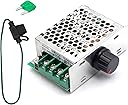
The RioRand 7-70V PWM DC Motor Speed Controller delivers up to 30A current with a wide voltage range, housed in a durable low-heat aluminum case. Designed exclusively for brushed DC motors, it offers smooth speed transitions, reliable overload protection, and easy wiring, making it the go-to choice for DIY enthusiasts and professionals seeking precise motor control in robotics, tools, and small electric devices.


| ASIN | B071NQ5G71 |
| Best Sellers Rank | #8,390 in Industrial & Scientific ( See Top 100 in Industrial & Scientific ) #1 in Motor Speed Controllers |
| Brand | RioRand |
| Brand Name | RioRand |
| Color | Green |
| Customer Reviews | 4.2 out of 5 stars 5,028 Reviews |
| Included Components | NO |
| Item Type Name | Motor Speed Controller Switch 30A |
| Item Weight | 4.48 ounces |
| Manufacturer | RioRand |
| Material | Iron |
| Material Type | Iron |
| Model | 7-70V PWM DC |
| Part Number | RR-MJLK-FBDG |
| Smart Home Compatibility | Not Smart Home Compatible |
| UPC | 637012215377 |
| Unit Count | 1.0 Count |
| Warranty Description | 3 months |
L**N
Works good
Works good, speed control knob spins kind of easy on bumps is my only complaint.
T**S
Works as described
Works great. This is a great product.
R**I
5 things to be aware of however OVERALL it appears to be built well.
over all it works fine for what I need a (test bench) speed controller for a PMDC 10 amp motor. Several things you will need to be aware of are 1) you will need an external on off switch, the onboard switch is NOT conveniently located for someone with big hands. 2) My input voltage was up to 60 vdc and with no soft start, unless you are starting from the minimum speed the motor will literally JUMP to lightspeed when started. 3) while it is running at a steady state periodically the controller output will HICCUP while running. not sure what causes that? Depending on your application that may be an issue. 4) The unit does not have an output voltage and/or amp meter (which is reflected in its price). 5)The motor ran smoothly and quietly while operating thru its whole speed range. However Zero was not 0 rpm the minimum output voltage was somewhere between (5-10%) 3 to 5 volts for my app. which left the motor still crawling at min speed position with no load applied to the motor. However with just my hand to create a small load the motor would stall. Running with no load on the motor (15 min max) the controller unit never got above room temp. Because of my application I am unable to put the motor (and therefore the controller) under a full load. The controller is rated at 30 Amps and my motor at full load is rated at 10 amps. OVERALL it appears to be built well. the value for the money is a fair price. Just be aware of the above mentioned Items for your application. Yes I'm happy with my purchase. The reason for the 4 ratting are the above items.
B**R
It does its job correctly
Very well made, just a warning. The voltage does go up when not powering the load. Meaning that you can bun stuff if you don't have the load on when turning power on. This is expected however I was not aware.
B**.
Works
I used this to reduce the voltage on a Power Wheels that now operates on a Dewalt 20V Max battery. The board appears to be relatively simple. I am not an experienced electrical technician, but the one feature I would have liked to see was some indication on the dial as to what voltage was being given. In lieu of this, I placed an LCD voltage monitor on the output side and can now monitor the voltage being sent to the motor, but it’s essentially useless as the meter will show high spikes of voltage and then drop, which I suspect is the result of the use of the lithium ion batteries. Nonetheless, when the dial is too low, the motor will not turn, and an adjustment of the dial will adjust in over-voltage, so this piece certainly does work.
D**L
when it works, it's great but it doesn't work for very long
purchased this ca Feb 2025 but just got around to using this and as others have described, worked GREAT for about 5 mins and then ONLY FULL POWER (no power control). I have a similar looking PWM from another vendor (DC Motor Speed Controller PWM Controller, Enmja 7-70V 30A Adjustable PWM Motor Speed Regulator 12V 24V 36V 48V) and this has been used extensively for about 1 year and it's fine. again, these 2 units LOOK ALIKE but clearly they aren't the same. also, I did some voltage measurements on the 2 units initially and the defective unit (before being used) required advancing the rheostat near 2/3 of its entire travel before it registered anything. that was until the controller failed resulting in 100% output and NO speed control at all. I'm going to order another of the previous model (still offered by Amazon as of 6/2025) since my experience with that has been positive. but I'll avoid this one that is defective. I'll also tear it apart to see if there is anything fixable (and cheaply) and if I come up with a solution, I'll post an update. one note: as others stated, when it works, it's great. it just doesn't work for very long.
N**K
Perfect for power wheels
Used this to upgrade my son’s 6volt ride on quad to use m12 batteries. I love that it has the adjustment knob. I mounted it under the fender and can quickly reach down and give it more power when he rides into thicker grass.
S**Z
Works but could be better
It works pretty well but the control knob is not very accurate. It seems to go from very low to high with not much in between.
M**C
Great variable speed control on dc motors
Used this controller on 12v radiator fans, and works like a charm. Easy wire up as well
P**B
Works Great
The red and blue display is very attractive, substantially nicer than the photo supplied by Amazon. Like the DROK unit, voltage and current readings can be adjusted by 2 pots, if necessary, for improved accuracy. Lots of people will want to measure LESS than 10 amps (removing the necessity to use a shunt). Why, then, do all the wiring diagrams for this item show a shunt? I've included a corrected diagram and also a picture of ten 5mm LEDs wired in parallel and used as a load. If the purpose for the device is actually to measure the downsteam volts and amps coming from a 265 watt (nominal) solar panel, just remember that the 33 volts produced in the noon sun exceeds the Vcc rating that powers the volt-ammeter itself, but is well under the input voltage rating of 100Vdc. The solar 8 amps being available at maximum is nicely under the 10 amp limitation (and for much of the day the reading will be closer to 4 amps). Just make sure to consider your solar controller as the load, so the thick YELLOW wire all by itself is what connects to the controller's PV negative terminal. The 265 watt solar panel is the input source and provides the connection points somewhere downstream (but before the controller) for the thick RED and BLACK wires. If this volt-ammeter is meant to be a temporary tester only (as in my case) then a 9 volt battery will comfortably power this device for a few hours.
A**N
Excellent product. Tested it as soon as I received ...
Excellent product. Tested it as soon as I received it and works great. For those of you looking for instructions here's how I used it: The thin red and black wires are to power the unit. This requires a voltage between 5V~30Vdc to work reliably. Below 5V, the display goes dim. Once you've powered the unit, it will display the source voltage in red digits. Now for the load current you use the thick RED, BLK and YEL wires - connect the RED & BLK to the +ve and -ve terminals of your power source respectively. Now connect the +ve of your "load' to the +ve of the power source and -ve of your "load" to the YEL wire. This should supply current to your load and display the load current in the blue display. Hope this helps.
J**T
Bien
Beau morceau, fonctionne bien. Doit avoir des notions électrique pour le brancher
D**L
Good for auto rad fan(S)
I find these speed controllers work well with after market electric rad fans. As a bonus it is simple to add a thermistor to the device for auto speed control. The thermistor I used has a resistance of (approx)13.35K ohms @(approx)19.5C ( temperature) and the resistance decreases as the thermistor warms. To wire in the thermistor you are simply wiring it in parallel with the potentiometer ( speed control adjust ). 3 wires out of the potentiometer on the board, hook up the thermisitor wires (2) to the two outside wires coming from the potentiometer- very easy. The board speed control knob can be adjusted to suit desired minimum cold engine speed or no speed depending on the application etc.
Trustpilot
1 week ago
2 weeks ago