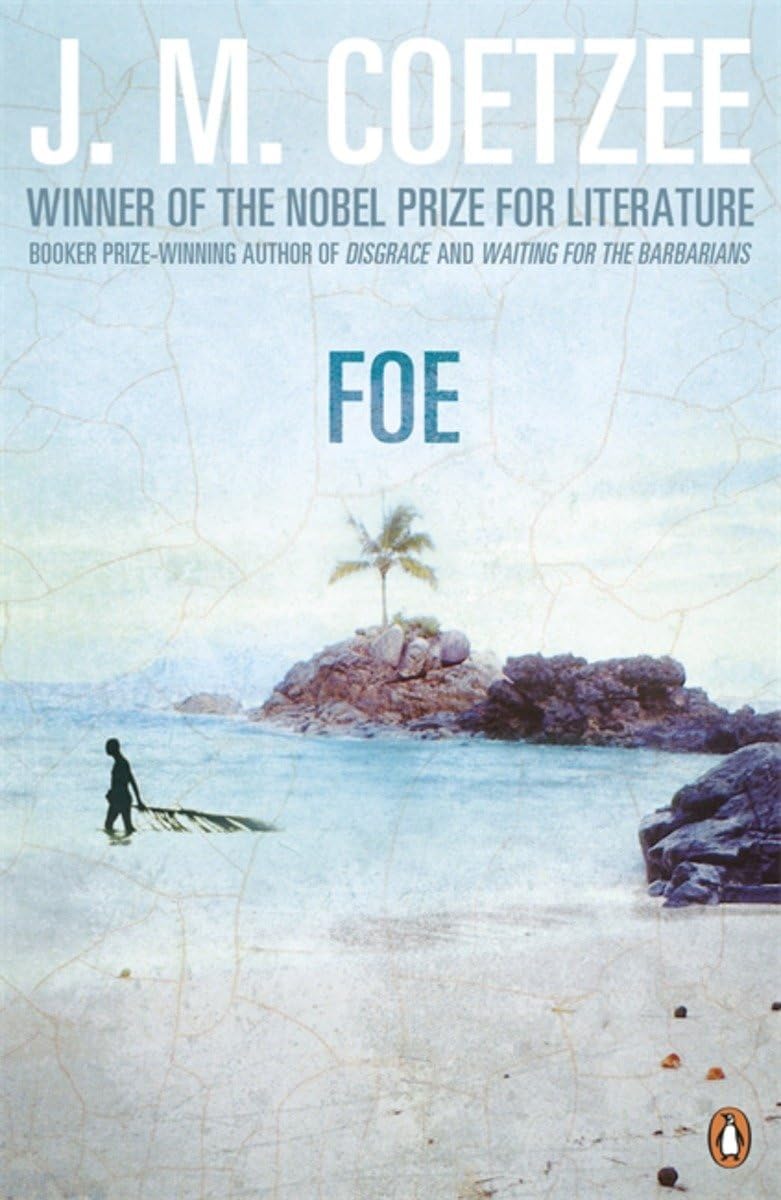
Foe
Product ID: 355226672
🏆Nobel & 2x Booker Prize-winning author
📚160 pages of literary depth
🕰️Reimagines 18th-century classic
Desertcart purchases this item on your behalf and handles shipping, customs, and support to UK.
📖 Unlock the untold story behind the legend — where freedom meets fierce storytelling.
Foe is a 160-page paperback by Nobel Laureate J.M. Coetzee that reimagines Daniel DeFoe's Robinson Crusoe through a feminist and postcolonial lens. This critically acclaimed novel explores themes of narrative control, freedom, and voice, blending historical fiction with intellectual depth. Highly rated and ranked among top historical fiction titles, it offers a compact yet powerful literary experience.
| Best Sellers Rank | #199,049 in Books ( See Top 100 in Books ) #3,779 in Historical Fiction #4,268 in Action & Adventure Fiction #7,784 in Contemporary Literature & Fiction |
| Customer Reviews | 4.4 out of 5 stars 263 Reviews |
A**E
"Foe", a hypnotizing portrait of human turbulence
"Foe" begins like an epic poem requiring all six senses to tune in. Our protagonist is a young woman struggling to survive. She fascinates like a spider constructing her web. Her rhythmic motions, her sensual fiber, her instinctive powers and her appetite for natural beauty guide the scene with all its vital ingredients--terror, exhaustion, suspicion, satisfaction, failure, passion, anger, triumph. With the completion of the web, in all its silky and resilient perfection, the reader exalts in the young woman's victory, but not for long. This is not a straightforward story. The reader has fallen into the web or so it seems. Frustration at first irritates and then infuriates. The memory of a beautiful tale drifts out of focus. Truth evades. The reader, overcome by his incapacity to react wraps himself in a sticky state of inertia--a frail observer of a ever more vanishing truth. But not all webs are constructed to trap a prey. Spiders sometimes simply gloat with the pleasure over a perfect exercise. And so very slowly after the mental anguish there comes the relaxed appreciation of an unreachable beauty, a truth suspended forever in time like John Keats' lovers on a Grecian urn. "Forever wilt thou love and she be fair!" A vision of an unattainable success. J. M. Coetzee deserves a poet's laurel wreath for this hypnotizing portrait of human turbulence. I highly recommend J.M. Coetzee's "Foe".
R**E
Another Crusoe
"I am not a story, Mr. Foe. I may impress you as a story because I began my account of myself without preamble, slipping overboard into the waves and striking out for the shore. But [...] there was a life before the water [...] which makes up a story I do not choose to tell. [...] I am a free woman who asserts her freedom by telling her story according to her own desire." The woman is Susan Barton, speaking to the writer Daniel Defoe (he added the "de" to his family name later). Rescued after being cast away on the Caribbean island, she has sought out the author to write her story and make her fortune. Her island adventure, which she tells in the first part, is a rather different version of the story that we know from ROBINSON CRUSOE . But the larger part of the book consists of a dialogue between Susan and Foe, partly in letters, partly in person, examining the themes referred to here: the nature of the writing process, the way our lives are shaped by the stories we choose to tell about them, and above all the meaning of freedom, especially as a woman or a member of a subjugated race. Cruso (as the name is spelled here) was already on the island when Susan got there. Instead of the numerous items that Defoe will allow him to salvage from the wreck, Susan's Cruso came ashore with nothing but a knife and lives much more simply. So far from being rescued from cannibals, Friday was washed ashore with him, but he is a mute whose tongue has been cut out in childhood. At sixty, Cruso has no wish to leave the island, and when a ship does arrive to carry them away, he dies on the voyage, leaving Susan as the only witness, other than Friday who cannot speak. Susan continues to write to Foe, even after he has been forced to flee his creditors. She takes possession of his empty house, sitting at the author's desk, writing letters that may never be delivered. But as she essentially shapes her own narrative, Defoe is simultaneously shaping hers, eventually writing her out of her own tale -- but also adding new elements as though to make a separate novel out of her, as he would later do with MOLL FLANDERS . Hence Susan's forcible objections in the quotation with which I started. Indeed, Defoe's inventions come to take surreal form, as Susan is visited by a long-lost daughter conjured from the writer's imagination in response to her grief, but bearing no resemblance to her real child. Coetzee's interest in recursive narratives has continued to the present day, as in his recent SUMMERTIME , but this 1986 novel is the most intellectually abstract of his that I have read, though fascinating in the manner of an Escher drawing. But there are serious points behind the mind-games. Most obviously, the feminist complaint that although Susan can serve as Foe's muse, she has no control over the artistic progeny. Her castaway story will be reshaped with the relatively passive Crusoe as hero, whereas Defoe's heroines would all be fallen women. Even more interesting, for a South African author writing under Apartheid, is the silencing of Friday. Unable to speak for himself, unable even to write, Friday's existence depends entirely on those who write his story for him, and even Susan's willingness to accord him the freedom she claims for herself is valueless without the ability to give him the narrative to support it.
G**I
Molto bene
Non mi sento di consigliare particolarmente questo libro, ma do una recensione positiva in quanto è arrivato velocemente e in ottimo stato
C**A
E se Crusoé fosse louco, e Sexta-feira mudo?
Muito boa literativa pós colonial, a intertextualidade é de uma ironia deliciosa. Recomendo a todos que queiram uma nova visão sobre o clássico de Dafoe.
I**L
Masterpiece
This book is a gem
Trustpilot
2 weeks ago
2 months ago