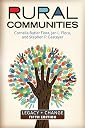
Rural Communities: Legacy + Change
Product ID: 18275376
Desertcart purchases this item on your behalf and handles shipping, customs, and support to UK.
Communities in rural America are a complex mixture of peoples and cultures, ranging from miners who have been laid off in West Virginia, to Laotian immigrants relocating in Kansas to work at a beef processing plant, to entrepreneurs drawing up plans for a world-class ski resort in California's Sierra Nevada. Rural Communities: Legacy and Change uses its unique Community Capitals framework to examine how America's diverse rural communities use their various capitals (natural, cultural, human, social, political, financial, and built) to address the modern challenges that face them. Each chapter opens with a case study of a community facing a particular challenge, and is followed by a comprehensive discussion of sociological concepts to be applied to understanding the case. This narrative, topical approach makes the book accessible and engaging for undergraduate students, while its integrative approach provides them with a framework for understanding rural society based on the concepts and explanations of social science. This fifth edition is updated throughout with 2013 census data and features new and expanded coverage of health and health care, food systems and alternatives, the effects of neoliberalism and globalization on rural communities, as well as an expanded resource and activity section at the end of each chapter. Review: Clear and concise. - Used for a graduate school course in community development. Easy to read & understand concepts Review: Excellent book, quick delivery. - This book was extremely informative and was delivered quickly after I signed up for fall 2019 term undergraduate course (Human Services in Rural Communities). There are a lot of historical, statistical, and anecdotal examples/information that helped understand the issues facing the rural and non-rural population.


| Best Sellers Rank | #971,348 in Books ( See Top 100 in Books ) #260 in Sociology of Rural Areas #533 in Government Social Policy #604 in Public Policy (Books) |
| Customer Reviews | 4.5 out of 5 stars 75 Reviews |
A**N
Clear and concise.
Used for a graduate school course in community development. Easy to read & understand concepts
J**E
Excellent book, quick delivery.
This book was extremely informative and was delivered quickly after I signed up for fall 2019 term undergraduate course (Human Services in Rural Communities). There are a lot of historical, statistical, and anecdotal examples/information that helped understand the issues facing the rural and non-rural population.
C**N
Good book
Good textbook for rural geography class
W**G
Great introduction to community capitals
This book is a great introduction to the community capitals. While the examples sometimes feel like they're being hurled at you with little additional information, the reader must remember that it's an introductory book. If you want more depth, there are additional resources given in the book. This edition provides less detailed information in the "Social Capitals" chapter, which is a shame.
S**A
Good
Good price
B**Y
How grass-roots cooperation can effect change.
Here’s an example of business butting heads with government; a rancher gets fed up with Colorado elk damaging his fences, but the state wildlife authorities always say the same thing; no shooting! He organizes a conference with the authorities, local hunters, ranchers, farmers, and whether they’re invited or not, the “tree huggers.” Both sides dislike each other; the ranchers think of environmentalists as a nuisance, and the environmentalists regard the ranchers as resource-raiders. They do have something in common, in that they both want the elk to live. Without the elk, there won’t be any hunting. But at the same time, without the rancher’s cows, there won’t be any burgers, and the meat industry will lose jobs. The conflict between the rancher and the wildlife authorities is one of many examples that the author gives in his book. Rural Communities discusses how far flung and remote communities can collectively effect change, but it requires a great deal of grass-roots effort. Unenlightened about progressive ways, the locals, whether rich or poor, can have a tough time working together to achieve goals. If a town depends on a coal mine for jobs, and the people want something done about pollution, there will be conflict. In the chapter Culture Capital and the Family, we see how the rural working class miners, loggers, and farmers clash with the educated residents. The working classes may view the more educated ones as an adversary, but at the same time, the farmers will suffer if mine tailings pollute the water. If the forest is logged down to stumps, there won’t be any deer hunting. If the water is silted from strip mining, you can forget about fishing. Another issue in this book with regard to economics is the conflict between industry and education. Blue collar wages are often higher than those for teachers and office workers, so why go to school? If you can make $45,000 a year in a coal mine and much less as a teacher, then why would a kid want to go to school? The author discusses how some towns invest in technical education, which benefits the industry, but labor skills can just as easily be learned on the job. There are links here to the world economy to world economy, such as tariffs on imported produce and coal. But even tariffs can’t save a company town, because the demand for cheap furniture outpaces the need for quality. A furniture factory in the USA, with regulations on waste disposal and work hours, can’t compete with a factory in China. For all we know, a Chinese factory could be using slave labor. There weren’t a lot of surprises here, because I’ve seen country towns with municipal conflicts between all classes. Anyone who saw the 20/20 episode titled Hidden America: Children of the Mountains can see the problems with drugs, health, pollution, and crime that rural towns can have. But I thoroughly enjoyed the case studies that the author uses. He makes clear that when a town can’t reach a consensus, everything stalls and there’s no improvement.
C**Y
Incorrect page numbers and pages missing!
The pages are numbered wrong and there are pages missing! This is crazy to me since it is a DIGITAL version of the book! I am using this book for community studies 101 in college, so it is really frustrating! I am only on page 24 and at least 3 times now multiple pages have had the same number on them. There are also missing pages, but I don't know how many because the page numbers will be in order. I was just reading page 25, turned to page 26 and the rest of the sentence I was reading was gone and a whole new paragraph started.
K**N
Great price
Great book for great price as opposed to bookstore prices for college course.
Trustpilot
3 weeks ago
1 month ago