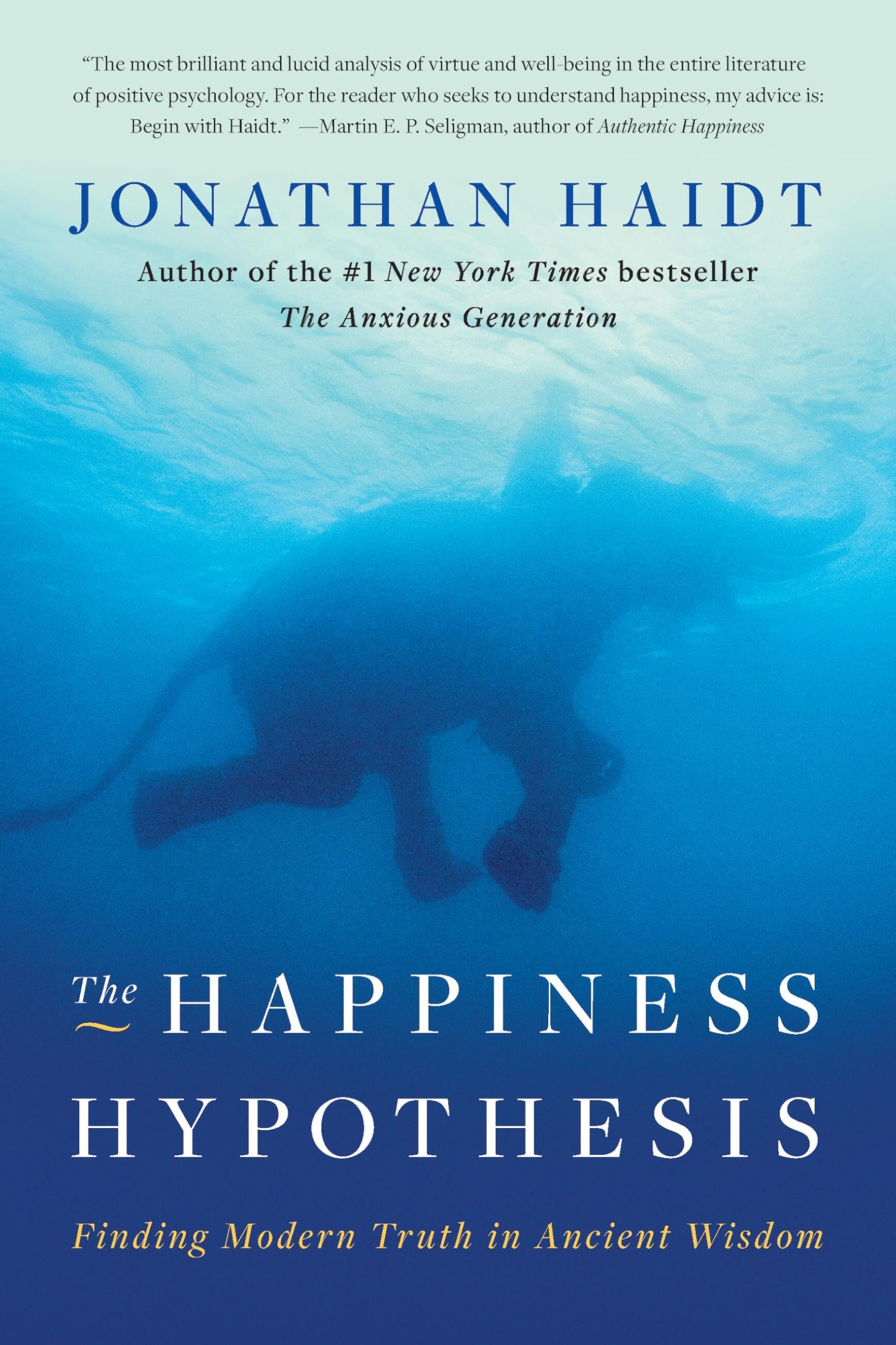
The Happiness Hypothesis: Finding Modern Truth in Ancient Wisdom
Product ID: 1499626
Buy anything from 5,000+ international stores. One checkout price. No surprise fees. Join 2M+ shoppers on Desertcart.
Desertcart purchases this item on your behalf and handles shipping, customs, and support to UK.
The author of the #1 New York Times bestseller The Anxious Generation shows how a deeper understanding of the world's philosophical wisdom can enrich and transform our lives The Happiness Hypothesis is a book about ten Great Ideas. Each chapter is an attempt to savor one idea that has been discovered by several of the world's civilizations—to question it in light of what we now know from scientific research, and to extract from it the lessons that still apply to our modern lives and illuminate the causes of human flourishing. Award-winning psychologist Jonathan Haidt shows how a deeper understanding of the world's philosophical wisdom and its enduring maxims—like "do unto others as you would have others do unto you," or "what doesn't kill you makes you stronger"—can enrich and transform our lives. Review: Read. Absorb. Enjoy. - I came to this book from Haidt’s wonderful study, THE RIGHTEOUS MIND, which I highly recommend. Given the subject, this book is a bit more diffuse and a little less certain in its conclusions but it is still a wonderful read and an insightful study. It is also a ‘big’ book, i.e. a book that tackles an extremely important subject. I would note, first and foremost, that this is a scholarly book accessible to a wide audience. The writing is lucid and straightforward, jargon-free and not disrupted by endless annotation, charts, graphs and statistics. Most important, perhaps, is its attempt to bring together both psychological science and the humanities. On one page you might receive a report of a study in neuroscience utilizing fMRI technology, on the next the thoughts of Epictetus or Epicurus. While it has often been said that Freud learned as much from literature as from science, that pattern of investigation is now very rare. The ‘psychological sciences’ are now very distinct from the humanities and their work is heavily-funded, empirical science. They associate themselves with the biomedical sciences far more than with the departments of Philosophy or, e.g., Religious Studies. Nevertheless, the literature of reason, wisdom and faith has much to say of, e.g., human happiness and it is to JH’s considerable credit that he measures that literature against the (always tentative) conclusions of modern psychological science. Is Plato’s sense of the divided self a good metaphor for human nature and behavior? Is it true that what doesn’t kill us makes us stronger, as Nietzsche argued? How should we look at Emerson’s transcendentalism in light of the common human desire for such experience? Given the fact that the subject is so vast—the nature of man, the nature of man’s quest for happiness, the very nature of ‘happiness’ and the strategies for achieving it—the conclusions are complex. Nevertheless, they can be summarized briefly. As in THE RIGHTEOUS MIND, JH adopts a Humean model in which the Reason is, ultimately, the slave of the passions. Our lives consist of a multiplicity of experiences that rumble about in our consciousness and direct our ‘automatic’ responses to concrete situations. Joshua Reynolds talked about this phenomenon under the rubric of ‘intuition’. Intuition is not a simple, largely-unwarranted gut reaction; it is the sum total of millions of experiences summoned instantly to respond to a current situation. I am standing beside a highway or a city street. Cars are passing by at various rates of speed. I want to get to the other side of the street, quickly, efficiently and safely. I make instant mental calculations and act . . . . Reason, on the other hand, is something that we utilize when we are pressed to find an argument for an intellectual position. It is, in part, a rhetorical device: how can I outwit and defeat my opponent in the most clever and efficacious fashion? JH takes these phenomena and constructs the ongoing metaphor of a man riding an elephant. The elephant is the sum total of the work of the ‘passions’. He is experience, intuitions, inclinations, and so on. The rider is the Reason. He attempts to control the elephant but that process is complex and sometimes arduous. As we are, in a sense, ‘divided’, so is our world and our experience. So are our bodies. The trick is to put all of this together (with a little luck; being in the right place at the right time helps immeasurably). Here is JH’s conclusion: “We were shaped by individual selection to be selfish creatures who struggle for resources, pleasure, and prestige, and we were shaped by group selection to be hive creatures who need love and attachments, and we are industrious creatures with needs for effectance, able to enter a state of vital engagement with our work. We are the rider and we are the elephant, and our mental health depends on the two working together, each drawing on the others’ strengths. . . . . Happiness is not something that you can find, acquire, or achieve directly. You have to get the conditions right and then wait. . . . Just as plants need sun, water, and good soil to thrive, people need love, work, and a connection to something larger. It is worth striving to get the right relationships between yourself and others, between yourself and your work, and between yourself and something larger than yourself” (pp. 238-39). Bottom line: a lovely book that all should read, absorb and enjoy. Review: Wonderful - Jonathan Haidt is a thinker who seeks harmony where possible, and his book The Happiness Hypothesis strives to achieve a fruitful balance between ancient wisdom and modern science, between East and West, and between liberalism and conservatism. The overriding metaphor of the book involves portraying the mind as as an elephant and its rider, which Haidt uses to explore the insights of evolutionary psychology. Crucial here is the distinction between automatic and controlled processes. The rider represents rationality (a controlled process), which has evolved to serve the elephant, which represents everything else (automatic processing such as intuitions, instincts and visceral reactions.) The rider and elephant work best when they work together, and the rider can influence the elephant, but the rider is not in charge, and Haidt elaborates how and why the interaction between rider and elephant is often dysfunctional. Though the notion that the mind is divided is hardly novel, Haidt provides a thought provoking, scientifically updated and defensible interpretation of this point of view. Haidt views the notion that “there is nothing either good or bad, but thinking makes it so” as the root of much ancient wisdom. Haidt sees this Stoic and Eastern quest for serenity through acceptance as having beneficial aspects, but considers it as only part of the happiness equation. And to the extent that this quest is important, a particular criticism of the Western sages is that their valorization of reasoned insight as a freedom producing tool does not accord with our modern understanding of the mind. Though I’m sure Haidt would not dissuade a reader from tackling Marcus Aurelius or Boethius, he prefers cognitive behavioral therapy as a scientifically updated version of Boethius-like cognitive reframing activities that takes account of the powerful Elephant and its tendency-as seen through our evolved negativity bias-to be be pessimistic. As Haidt puts it: “Cognitive therapy works because it teaches the rider how to train the elephant rather than how to defeat it directly in an argument.” Haidt is also a big fan of meditation, an ancient practice that tames and calms the elephant directly. Haidt also is a supporter of SSRI’s like Prozac, and thinks that since our affective style-which reflects the balance of power between our approach and withdrawal systems-turns out to be largely genetically determined (though meditation and cognitive therapy shows there is obviously some room for self-improvement), SSRI’s can benefit some losers of the “cortical lottery” who otherwise might have very limited prospects for relief from depression, anxiety and the like. Haidt points out that group life is enabled to a great degree by reciprocal “tit for tat” strategizing, and says such behavior is absolutely critical for personal happiness. However, there are problematic complications. Seeming to be a good team player is more practically important than the reality, and persuading others of our good intentions works better when we are convinced of these intentions ourselves regardless of the facts. Haidt notes “we are well-armed for battle in a Machiavellian world of reputation manipulation, and one of our most important weapons is the delusion that we are non-combatants.” This applies both to persons as individuals and to persons to the extent they identify as members of groups. Haidt explores concepts like the inner lawyer, the rose-colored mirror, naive realism, and the myth of pure evil to argue that we have come equipped with evolved cognitive processes that predispose us to hypocrisy, self-righteousness, and moralistic conflict. Haidt also thinks evolutionary pressures have certainly contributed to often joyless “rat race” pursuits and their accompanying worries: “the elephant cares about prestige, not happiness.” Pursuing happiness necessitates becoming aware of and dissatisfied with the various self-promoting games we all tend to play-see his discussion regarding the progress and adaptation principles and the resulting weak relationship between environment and happiness-and striking out in a new direction. Haidt thinks that adversity is crucial for helping people to reassess and make meaningful alterations in their lives, and to develop greater coherence across what he takes to be the three levels of personality (basic traits, characteristic adaptations, and life story), all of which promotes human flourishing. He talks a lot about post traumatic growth-and he thinks that this insight if taken seriously has profound implications for how we structure our society and our lives. Haidt acknowledges, though, that one can experience too much adversity, and that it can strike at unhelpful stages in life. He thinks that adversity tends to be most profitable if experienced when one is in his/her 20’s. Though Haidt doesn’t mention it in his book, an obvious application here applies to college campuses. Haidt is a well known defender of free speech at the University level who laments the stultifying effects of PC orthodoxy on intellectual inquiry; if he is right about the 20’s being the best time to experience post-traumatic growth, than one could also criticize PC “snowflake culture” on the contemporary college campus as a factor inhibiting personal development because of excessive sheltering. Haidt provides a Happiness equation, H=S+C+V, where S stands for the biological set point (the affective style, which can be altered to a degree), C stands for conditions (some of which are inalterable and others which can be changed), and V stands for voluntary activities. A stoic or an Eastern sage would define the happiness equation as merely H=S+V, with the voluntary activities in question being those that promote serene acceptance, thereby improving S. Haidt builds on this beginning, however, insisting that yes, there are conditions and other voluntary activities that matter. Meaningful relationships are important for Haidt, and by exploring attachment theory, he particularly argues for companionate love as a condition that definitely bolsters happiness. And utilizing the scholarship of Mihalyi Csikszentmihalyi, he points to activities that promote “flow” as part of the happiness equation as well. Summing up, if what one might call “the wisdom of the East” taught that happiness was to be found within, Haidt says that it is to be found within and without, though we need to be very discerning about where to look for it outside ourselves. Haidt refines his outlook on happiness even further. We can find love in relationships and strive to find flow-ideally in our work-but Haidt goes further by speaking of “vital engagement,” a relationship to the world that is characterized both by experiences of flow and by meaning. Haidt’s vital engagement prioritizes journey over destination, an outlook that accords well with what he has to say about the effectance motive and the related progress principle. For Haidt, vital engagement is another way of saying that work has become love made visible. Haidt’s revised outlook on happiness is that it “comes from between;” since vital engagement exists in the relationship between the person and the environment, this right relationship is not entirely up to the individual. Accordingly, Haidt emphasizes the importance of cross-level coherence between the physical, psychological, and sociocultural realms for creating a sense of meaning conducive to happiness. The liberal atheist Haidt-he has since started calling himself a political centrist- thus appreciates conservative, durkheimian insights into the importance of “community” for human flourishing, views the “character” approach to ethics as superior to the long dominant rationalist “quandry” approach, sees virtuous behavior as conducive to happiness, conceives of the perception of the “divine” as natural to man and as ennobling, regardless of whether or not God actually exists, and writes appreciatively of the work of David Sloan Wilson regarding religion as a evolutionary group adaptation designed to promote cross-level coherence. Haidt thinks the scientific community should accept religiosity as a normal and healthy aspect of human nature, and that maybe non-religious people can learn something from religious people, whether or not they believe in God. Haidt’s book was a pleasure to read, and has spurred my interest regarding many authors and texts he weaves into his argument. In addition to opening new vistas and providing food for thought over a host of topics, evolutionary psychology in Haidt’s hands helps support time honored components of the “good life” such as family, vocational calling, faith, and community. And his own academic career strikes me as an example of the vital engagement he valorizes. This book is definitely worth a read.


| Best Sellers Rank | #20,195 in Books ( See Top 100 in Books ) #6 in Consciousness & Thought Philosophy #16 in Social Philosophy #350 in Motivational Self-Help (Books) |
| Customer Reviews | 4.6 out of 5 stars 5,188 Reviews |
R**Z
Read. Absorb. Enjoy.
I came to this book from Haidt’s wonderful study, THE RIGHTEOUS MIND, which I highly recommend. Given the subject, this book is a bit more diffuse and a little less certain in its conclusions but it is still a wonderful read and an insightful study. It is also a ‘big’ book, i.e. a book that tackles an extremely important subject. I would note, first and foremost, that this is a scholarly book accessible to a wide audience. The writing is lucid and straightforward, jargon-free and not disrupted by endless annotation, charts, graphs and statistics. Most important, perhaps, is its attempt to bring together both psychological science and the humanities. On one page you might receive a report of a study in neuroscience utilizing fMRI technology, on the next the thoughts of Epictetus or Epicurus. While it has often been said that Freud learned as much from literature as from science, that pattern of investigation is now very rare. The ‘psychological sciences’ are now very distinct from the humanities and their work is heavily-funded, empirical science. They associate themselves with the biomedical sciences far more than with the departments of Philosophy or, e.g., Religious Studies. Nevertheless, the literature of reason, wisdom and faith has much to say of, e.g., human happiness and it is to JH’s considerable credit that he measures that literature against the (always tentative) conclusions of modern psychological science. Is Plato’s sense of the divided self a good metaphor for human nature and behavior? Is it true that what doesn’t kill us makes us stronger, as Nietzsche argued? How should we look at Emerson’s transcendentalism in light of the common human desire for such experience? Given the fact that the subject is so vast—the nature of man, the nature of man’s quest for happiness, the very nature of ‘happiness’ and the strategies for achieving it—the conclusions are complex. Nevertheless, they can be summarized briefly. As in THE RIGHTEOUS MIND, JH adopts a Humean model in which the Reason is, ultimately, the slave of the passions. Our lives consist of a multiplicity of experiences that rumble about in our consciousness and direct our ‘automatic’ responses to concrete situations. Joshua Reynolds talked about this phenomenon under the rubric of ‘intuition’. Intuition is not a simple, largely-unwarranted gut reaction; it is the sum total of millions of experiences summoned instantly to respond to a current situation. I am standing beside a highway or a city street. Cars are passing by at various rates of speed. I want to get to the other side of the street, quickly, efficiently and safely. I make instant mental calculations and act . . . . Reason, on the other hand, is something that we utilize when we are pressed to find an argument for an intellectual position. It is, in part, a rhetorical device: how can I outwit and defeat my opponent in the most clever and efficacious fashion? JH takes these phenomena and constructs the ongoing metaphor of a man riding an elephant. The elephant is the sum total of the work of the ‘passions’. He is experience, intuitions, inclinations, and so on. The rider is the Reason. He attempts to control the elephant but that process is complex and sometimes arduous. As we are, in a sense, ‘divided’, so is our world and our experience. So are our bodies. The trick is to put all of this together (with a little luck; being in the right place at the right time helps immeasurably). Here is JH’s conclusion: “We were shaped by individual selection to be selfish creatures who struggle for resources, pleasure, and prestige, and we were shaped by group selection to be hive creatures who need love and attachments, and we are industrious creatures with needs for effectance, able to enter a state of vital engagement with our work. We are the rider and we are the elephant, and our mental health depends on the two working together, each drawing on the others’ strengths. . . . . Happiness is not something that you can find, acquire, or achieve directly. You have to get the conditions right and then wait. . . . Just as plants need sun, water, and good soil to thrive, people need love, work, and a connection to something larger. It is worth striving to get the right relationships between yourself and others, between yourself and your work, and between yourself and something larger than yourself” (pp. 238-39). Bottom line: a lovely book that all should read, absorb and enjoy.
D**H
Wonderful
Jonathan Haidt is a thinker who seeks harmony where possible, and his book The Happiness Hypothesis strives to achieve a fruitful balance between ancient wisdom and modern science, between East and West, and between liberalism and conservatism. The overriding metaphor of the book involves portraying the mind as as an elephant and its rider, which Haidt uses to explore the insights of evolutionary psychology. Crucial here is the distinction between automatic and controlled processes. The rider represents rationality (a controlled process), which has evolved to serve the elephant, which represents everything else (automatic processing such as intuitions, instincts and visceral reactions.) The rider and elephant work best when they work together, and the rider can influence the elephant, but the rider is not in charge, and Haidt elaborates how and why the interaction between rider and elephant is often dysfunctional. Though the notion that the mind is divided is hardly novel, Haidt provides a thought provoking, scientifically updated and defensible interpretation of this point of view. Haidt views the notion that “there is nothing either good or bad, but thinking makes it so” as the root of much ancient wisdom. Haidt sees this Stoic and Eastern quest for serenity through acceptance as having beneficial aspects, but considers it as only part of the happiness equation. And to the extent that this quest is important, a particular criticism of the Western sages is that their valorization of reasoned insight as a freedom producing tool does not accord with our modern understanding of the mind. Though I’m sure Haidt would not dissuade a reader from tackling Marcus Aurelius or Boethius, he prefers cognitive behavioral therapy as a scientifically updated version of Boethius-like cognitive reframing activities that takes account of the powerful Elephant and its tendency-as seen through our evolved negativity bias-to be be pessimistic. As Haidt puts it: “Cognitive therapy works because it teaches the rider how to train the elephant rather than how to defeat it directly in an argument.” Haidt is also a big fan of meditation, an ancient practice that tames and calms the elephant directly. Haidt also is a supporter of SSRI’s like Prozac, and thinks that since our affective style-which reflects the balance of power between our approach and withdrawal systems-turns out to be largely genetically determined (though meditation and cognitive therapy shows there is obviously some room for self-improvement), SSRI’s can benefit some losers of the “cortical lottery” who otherwise might have very limited prospects for relief from depression, anxiety and the like. Haidt points out that group life is enabled to a great degree by reciprocal “tit for tat” strategizing, and says such behavior is absolutely critical for personal happiness. However, there are problematic complications. Seeming to be a good team player is more practically important than the reality, and persuading others of our good intentions works better when we are convinced of these intentions ourselves regardless of the facts. Haidt notes “we are well-armed for battle in a Machiavellian world of reputation manipulation, and one of our most important weapons is the delusion that we are non-combatants.” This applies both to persons as individuals and to persons to the extent they identify as members of groups. Haidt explores concepts like the inner lawyer, the rose-colored mirror, naive realism, and the myth of pure evil to argue that we have come equipped with evolved cognitive processes that predispose us to hypocrisy, self-righteousness, and moralistic conflict. Haidt also thinks evolutionary pressures have certainly contributed to often joyless “rat race” pursuits and their accompanying worries: “the elephant cares about prestige, not happiness.” Pursuing happiness necessitates becoming aware of and dissatisfied with the various self-promoting games we all tend to play-see his discussion regarding the progress and adaptation principles and the resulting weak relationship between environment and happiness-and striking out in a new direction. Haidt thinks that adversity is crucial for helping people to reassess and make meaningful alterations in their lives, and to develop greater coherence across what he takes to be the three levels of personality (basic traits, characteristic adaptations, and life story), all of which promotes human flourishing. He talks a lot about post traumatic growth-and he thinks that this insight if taken seriously has profound implications for how we structure our society and our lives. Haidt acknowledges, though, that one can experience too much adversity, and that it can strike at unhelpful stages in life. He thinks that adversity tends to be most profitable if experienced when one is in his/her 20’s. Though Haidt doesn’t mention it in his book, an obvious application here applies to college campuses. Haidt is a well known defender of free speech at the University level who laments the stultifying effects of PC orthodoxy on intellectual inquiry; if he is right about the 20’s being the best time to experience post-traumatic growth, than one could also criticize PC “snowflake culture” on the contemporary college campus as a factor inhibiting personal development because of excessive sheltering. Haidt provides a Happiness equation, H=S+C+V, where S stands for the biological set point (the affective style, which can be altered to a degree), C stands for conditions (some of which are inalterable and others which can be changed), and V stands for voluntary activities. A stoic or an Eastern sage would define the happiness equation as merely H=S+V, with the voluntary activities in question being those that promote serene acceptance, thereby improving S. Haidt builds on this beginning, however, insisting that yes, there are conditions and other voluntary activities that matter. Meaningful relationships are important for Haidt, and by exploring attachment theory, he particularly argues for companionate love as a condition that definitely bolsters happiness. And utilizing the scholarship of Mihalyi Csikszentmihalyi, he points to activities that promote “flow” as part of the happiness equation as well. Summing up, if what one might call “the wisdom of the East” taught that happiness was to be found within, Haidt says that it is to be found within and without, though we need to be very discerning about where to look for it outside ourselves. Haidt refines his outlook on happiness even further. We can find love in relationships and strive to find flow-ideally in our work-but Haidt goes further by speaking of “vital engagement,” a relationship to the world that is characterized both by experiences of flow and by meaning. Haidt’s vital engagement prioritizes journey over destination, an outlook that accords well with what he has to say about the effectance motive and the related progress principle. For Haidt, vital engagement is another way of saying that work has become love made visible. Haidt’s revised outlook on happiness is that it “comes from between;” since vital engagement exists in the relationship between the person and the environment, this right relationship is not entirely up to the individual. Accordingly, Haidt emphasizes the importance of cross-level coherence between the physical, psychological, and sociocultural realms for creating a sense of meaning conducive to happiness. The liberal atheist Haidt-he has since started calling himself a political centrist- thus appreciates conservative, durkheimian insights into the importance of “community” for human flourishing, views the “character” approach to ethics as superior to the long dominant rationalist “quandry” approach, sees virtuous behavior as conducive to happiness, conceives of the perception of the “divine” as natural to man and as ennobling, regardless of whether or not God actually exists, and writes appreciatively of the work of David Sloan Wilson regarding religion as a evolutionary group adaptation designed to promote cross-level coherence. Haidt thinks the scientific community should accept religiosity as a normal and healthy aspect of human nature, and that maybe non-religious people can learn something from religious people, whether or not they believe in God. Haidt’s book was a pleasure to read, and has spurred my interest regarding many authors and texts he weaves into his argument. In addition to opening new vistas and providing food for thought over a host of topics, evolutionary psychology in Haidt’s hands helps support time honored components of the “good life” such as family, vocational calling, faith, and community. And his own academic career strikes me as an example of the vital engagement he valorizes. This book is definitely worth a read.
M**S
Generally well-argued and engrossing, but with one major flaw
Professor Haidt has written an excellent book that is as entertaining as it is informative. It does, however, have one major flaw that cost it a star in my rating. I'll discuss the flaw later - let me start with the positive. I won't summarize the book, as other reviewers have done so already. Let me just point out that Haidt is a very talented writer - "The Happiness Hypothesis" reads more like an engrossing novel than like a science book. While I was working my way through the volume, I would sometimes sit down with the intention to read just a few pages, only to realize later that an hour had passed. The book is not explicitly a self-help manual, but most of the material has fairly obvious implications that one can apply in one's own life. Chapter 4, for example, is all about hypocrisy and self-deception. (Incidentally, I'm surprised that Haidt didn't quote Scottish poet Robert Burns, who wrote, "O would some power the giftie gie us to see ourselves as others see us."). Haidt's version goes like this: "Even when you grab people by the lapels, shake them, and say, 'Listen to me! Most people have an inflated view of themselves. Be realistic!', they refuse, muttering to themselves, 'Well, other people may be biased, but I REALLY AM above-average on leadership.' ". Of course, I had only an academic interest in the chapter, but I did find myself wishing that I could force all my relatives and co-workers to read it, in the hopes that they might finally see themselves for who they really are (heh). Haidt's book is largely accurate, well-reasoned, and potentially helpful - with one major exception. In chapter 2, Haidt paints an unjustifiably rosy picture of antidepressant drugs. He claims that Prozac, Paxil, Zoloft, etc. are proven to work on "...an astonishing variety of mental maladies, including depression, generalized anxiety disorder, panic attacks, social phobia...". If Haidt had made this claim five years ago, then he might have been forgiven for ignoring data to the contrary. However, it's 2006 today, and there is no legitimate excuse for not warning readers that antidepressants have been linked to a variety of nasty side-effects, most notably suicidal behavior. Quite frankly, Haidt is being irresponsible here. The FDA recently forced pharmaceutical companies to add a "black box" warning to the documentation that accompanies antidepressants, yet Haidt never mentions this fact. Furthermore, a very careful analysis of clinical trials shows that antidepressants barely out-perform placebos. In trials of depression, both antidepressants and dummy pills produce dramatic improvements in about a third of experimental subjects, modest improvements in another third, and no change in the final third. I was surprised and disappointed that Haidt apparently set aside his skepticism when he discussed these drugs; his readers may suffer for it. (Just to be clear, I have absolutely no ties to groups that have religious objections to psychiatric drugs.) To summarize my review: "The Happiness Hypothesis" is well worth reading, with the caveat that parts of chapter 2 are inaccurate, misleading, and potentially harmful.
P**H
What religion and psychology say about human nature
Do the great religious traditions contain accurate insights about human nature? Jonathan Haidt examines ten great ideas about human nature from ancient religions. He evaluates the ideas in light of modern psychology, and he then extracts lessons to apply to our lives today. Using what he has learned, he presents his hypothesis about where happiness comes from. The result is a fascinating book. One common hypothesis is that happiness comes from getting what we want. This was rejected by, among others, Buddha, the Stoics, and the author of the Bible's book of Ecclesiastes. They correctly recognized that getting what we want provides but fleeting happiness. Within a day or two of attaining a goal, the effect wears off. A second hypothesis is that happiness comes from our evaluation of what happens. Buddha said, "our life is the creation of our mind." Haidt rates this as partially true. He contends that merely changing conscious thought won't bring lasting change unless the underlying decision making part of the brain is retrained from its usual worry and pessimism. We have a negativity bias. In other words, "bad is stronger than good; responses to threats and unpleasantness are faster, stronger and harder to inhibit than responses to opportunities and pleasures." Meditation and cognitive therapy can reduce depression and anxiety by training patients to catch and reframe distorted, exaggerated thoughts. Haidt is also an unabashed fan of Prozac and related drugs for their purported effectiveness for most people. That notion is strongly challenged in another book I've reviewed, Lost Connections (2018) by Johann Hari, who argues that drugs do not work well over time to treat depression. Contrary to Buddha, Haidt asserts that happiness comes in part from outside of ourself, if we know where to look. Shakespeare said, "Things won are done; joy's soul lies in the doing." In other words, we get satisfaction out of progress along the route to success. People get gratification from being fully engaged in a challenging activity that uses their talents to meet it, to accomplish or learn something, especially activity that involves social connections. After good or bad fortune, we always revert to our happiness setpoint or range, which is largely determined by heredity. Research shows that "most environmental and demographic factors influence happiness very little." Twin studies show that between 50-80% of the variance among people in average happiness is caused by genes rather than by their life experiences. External factors do influence whether we live on the high or low side of our probable happiness range or setpoint; among the factors that do influence happiness is a good marriage, "one of the life-factors most strongly and consistently associated with happiness." On the other hand, unhappily married people are the least happy group. Haidt contends that "happiness causes marriage. Happy people marry sooner and stay married longer than people with a lower happiness setpoint, both because they are more appealing as dating partners and because they are easier to live with as spouses. "We all have a basic need for dependable companionship, which is what a good marriage provides," writes Haidt. "While passionate love erupts rapidly and always declines, companionate love starts slowly and can continue to increase over a lifetime." Though Haidt is an atheist, he nonetheless recognizes that "religious people are happier, on average, than nonreligious people; this effect arises from the social ties that come with participation in a religious community, as well as from feeling connected to something beyond the self." Religion promotes strong ties among its members. Emile Durkheim, the father of sociology, concluded that people need obligations and constraints to provide structure and meaning to their lives. Durkheim discovered that suicide rises as social bonds and obligations decline. Single people have higher suicide rates, married people lower, and married with kids lower yet. Dense social connections matter to our ultrasocial species. "Reciprocity" is the single most important word to guide us, according to Confucius, Hillel and Jesus. It is a deep instinct, built into human nature, asserts Haidt, and the basic currency of social life. We seem to have a built-in system for keeping track of debts owed and favors granted. Social animals play tit for tat, returning favor for favor and insult for insult. Vengeance and gratitude are moral attitudes that reinforce tit for tat. Animals who only had generosity -- but not vengeance -- would be easy to exploit since it could be done without retaliation. Gossip is a mild form of vengeance since it is usually negative and about moral and social violations. Only one in ten gossip tidbits is positive. While gossiping has a bad reputation, almost everyone does it. If gossip didn't exist, Haidt says, then it would be easier for rude, selfish, antosocial acts to be gotten away with. "Gossip is a policeman and a teacher. Without it there would be chaos and ignorance...Gossip paired with reciprocity allows karma to work here on earth, not in the next life." Modern research supports the insight of Jesus and Buddha that human beings are exceptionally sharp in spotting faults, particularly in those we don't like. When it comes to ourselves, by contrast, we are reluctant to admit our flaws, and we judge ourselves much less harshly than we do our enemies. We are all hypocrites, Haidt asserts, and all are relatively blind to the logs in our own eyes (a reference to the verse in Matthew 7:3-5). Haidt argues that we need both the insights of ancient religion and of modern science. Those sources show that happiness comes under the right conditions. Some of the conditions are within, while others require relationships. "People need love, work, and a connection to something larger. It is worth striving to get the right relationships between yourself and others, between yourself and your work, and between yourself and something larger than yourself. If you get these relationships right, a sense of purpose and meaning will emerge." ###
C**N
Happiness = Setpoint + Conditions + Voluntary Activities
Scholars throughout history have written about happiness: What does a happy life look like? How do we achieve it? Should we be trying to? Obviously, there are no objective answers to these questions, we must all answer them for ourselves. Luckily for those of us living in the 21st century, we have science to help. In this book on happiness, our author Jonathan Haidt (professor of social psychology) combines ancient wisdom and modern social science to help point us in the right direction. One of the most important ideas developed by modern psychology is what is called the “happiness hypothesis,” and it is an equation that looks like this: Happiness = Setpoint + Conditions + Voluntary Activities. Our Setpoint is where we start, genetically. It turns out that “happiness is one of the most heritable aspects of personality. Twin studies generally show that from 50 percent to 80 percent of all the variance among people in their average levels of happiness can be explained by differences in their genes rather than in their life experiences.” This is an astounding revelation. The same way that recent research has diagnosed certain types of depression as genetically inherited, so are certain types of happiness. The Conditions of happiness are about love and work. “We are ultra-social creatures, and we can’t be happy without having friends and secure attachments to other people.” We need loving relationships that make us feel valued. We must also have and pursue the right goals in life “in order to create states of flow and engagement.” Basically, we have to feel a sense of meaning in relationship to others and also to what we spend the bulk of our time doing—hopefully something that contributes to society in what we deem to be a meaningful way. The more loving connections with others we sustain, and the more meaningful we feel as though our work is and our contributions are, the happier we will find ourselves. Voluntary Activities are also broken down into two categories: pleasures and gratifications. Pleasures are “delights that have clear sensory and strong emotional components” like eating great food, watching great movies, and having great sex. Gratifications are “activities that engage you fully, draw on your strengths, and allow you to lose self-consciousness.” Examples include singing in a choir or having an intense conversation with a friend. They can also be solo activities, like painting, writing, or photography, and are defined by the feeling of ‘flow,’ or total immersion in an activity. In addition to modern scientific studies, this book also has a collection of ancient wisdom woven in with it. Haidt touches on the similar beliefs of Stoicism and Buddhism which both say that “striving for external goods, or to make the world conform to your wishes, is always a striving after wind,” and that we are better served by breaking attachments to external things and cultivating an attitude of acceptance. He espouses the importance of living a virtuous life and examines the way the Ancient Greeks “focused on the character of a person and asked what kind of person we should each aim to become,” while modern ethics “focuses on actions, asking when a particular action is right or wrong.” He explores the benefits of spirituality, religion, and transcendence, noting that “anyone who wants a full, cross-level account of human nature, and of how human beings find purpose and meaning in their lives,” must recognize that connecting with something larger than the self is an important element in all cultures. Ultimately, happiness is not something that we can find, acquire, or achieve directly; we “have to get the conditions right and then wait.” Some conditions are within us, our Setpoint. Other Conditions require relationships to things beyond ourselves: Just as plants need sun, water, and good soil to thrive, people need love, work, and a connection to something larger. “If you get these relationships right, a sense of purpose and meaning will emerge,” he writes. Finally, combining these with our Voluntary Activities (how we spend our remaining time) will give us the proper recipe for a happy life: Happiness = Setpoint + Conditions + Voluntary Activities.
D**E
An Enjoyable Read!
I saw Chris Anderson (Wired Editor and TED co-founder) asked by Charlie Rose to name his favorite book of the last few years. "The Happiness Hypothesis" was the immediate response. Now this book is one of my favorites, too. The Happiness Hypothesis compares traditional philisohpical traditions with the lastest scientific discoveries, and the two ends meet well in the center. The author's own experiences provide narrative glue. A major finding is that happiness is a set point for us, and that after good times and bad, we tend to return to our general level of happiness. At the same time, we can do things that help or hurt our happiness, and we can understand better how our minds and emotions work. Factors that decrease happiness include persistent noise, lack of control, shame, dysfunctional relationships, and long commutes. Strong marriages, physical touch, meaningful relationships and religious affiliation tend to improve happiness. Activities with others enhance our happiness; status objects tend to separate us from others. In terms of parenting, Haidt finds that secure children are well supported by parents who are nearby, providing safety and security. Avoidant children are neglected by their parents. And resistant children have parents who alternate between support and neglect. Haidt also shows how moral relativism is not good for children. I was also fascinated by Haidt's observation that modernity and commercial culture slowly replaced the ideal of character with the idea personality, leading to a focus on individual preferences and personal fulfillment. This movement reached a height during the "values clarification" movement of the 1960s which taught no morality at all. The result of this is "anomie," a lost sense of self and right or wrong and feeling of being detached from other people and the world. One of the most hopeful sections of the book talks about Martin Seligman's work on positive psychology, and the rediscovery of virtue. Seligman and Chris Peterson researched wisdom traditions and found that these six virtues are common across almost all cultures: (1) Wisdom; (2) Courage; (3) Humanity; (4) Justice; (5) Temperance; (6) Transcendence. These six categories serve to organize 24 character traits. (You can find the complete list on Wikipedia.) The conclusion is that you should work to cultivate your strengths, not your weaknesses. This area of study is a great breakthrough after 100 years of the psychological study of mental illness. There were also many insightful nuggets I found in the excellent book, including: - How oxytocin, cortisols and endorphins effect health and behavior. - Haidt's belief that the chief causes of evil are moral idealism and high self-esteem. - Letting off steam makes you angrier, not calmer. - Wisdom is the ability to adapt, shape the environment, and know when to move to new environments. - Pleasure comes more from making progress toward goals than from achieving them. - Social constraints enhance happiness; total freedom decreases happiness (an insight seconded in "The Paradox of Choice"). - Trauma has benefits in that it shows how much adversity you can cope with. It also filters out false friends and changes priorities and philosophies toward the present. - Passionate love cannot last; companionate love is what lasts. - Haidt sees two types of diversity, demographic and moral. - The three major dimensions of social relationships are liking, status and morality/ transcendence. Coherence across these spectrums leads to happiness. - The six basic emotions that can be read on the face include joy, sadness, fear, anger, disgust and surprise. - Happiness often results from the collective elevation in a church or political rally. - The three levels of work are a job, a career and a calling. The more autonomy at work, the more happiness. - Vital engagement in the world leads to love made visible, which is a sign of deep happiness. - Work that does good for others and leads to income and recognition will enhance happiness. - Apostates who try to leave a group and traitors who undermine a group are subject to atrocities. - Group chanting can lead to mystical experiences, which provide a sense of spiritual connection that leads to happiness. - Eastern views and conservative politics focus on the collective, while Western views and liberal politics tend to focus on the individual. - Volunteerism increases happiness, and service learning in schools reduces dropout rates. This is a brilliant and sweeping narrative, and well worth the read. The cross-disciplinary nature of this work reminds me of EO Wilson's seminal work, Consilience. And parts of this book remind me of one of my favorite books of contemporary philosophy: Status Anxiety, by Alex de Bouten. Status Anxiety Consilience: The Unity of Knowledge
S**S
What is your calling?
I would imagine that while perhaps there are puts and takes, net-net there is reason for us to probably dance at least occasionally with happiness in life. Perhaps even that we are explicitly conscious of what makes us happy and the conditions that cause this happiness. A good job, a functioning family, stability & security, connection to a larger community, purpose, ability to access simple pleasures, friends and perhaps even reward & recognition. We know this. It may not all be there at once in all our lives, but we don't dispute that these are both common sense and empirically proven attributes of happiness. I myself have been a vigorous pursuer of such a state, not only implicitly, but explicitly after reading President Jefferson. In fact in my early twenties, I defined happiness in this manner I'm my essay titled, 'An Inalienable Right': "I find it difficult to define happiness. I am happy when I spend time with a good friend. I am happy when I read a book. There are many points in time when I instinctively realize that I am happy. It is a pleasant bodily feeling, an emotional fulfillment and an intellectual satisfaction. It is also more than that. My awareness of my happiness is acute in relation to moments when I am down or feeling low. The closest I can get to a definition of happiness is that it is a state of mental and physical well being created by a situation of completeness. Whether or not happiness can be defined, I know what it is to be happy. And I also know if I do certain things I become happy, or happier if I am already so. If I listen to music, my body might perhaps tingle. If I concentrate on a problem, a resolution begins to form. The question then becomes, could there be a set of universal principles which if influenced will produce happiness." Yet, we do have moments of doubt. If happiness is so understandable, why is there strife? What accounts for fundamentalism, that has gone as far as to cause physical harm to innocents? Are we 'tolerating' ancient truths? Are we skeptical of modern science's ability to cure what might ail the human condition? Are we quiet, non-fussy agnostics (not knowing what to believe, thus believe nothing, but quietly so). Are we also doubtful of what to teach our children? The world is changing rapidly and dynamically - What do we know about right in these changing circumstances? Do we cling to ancient traditions or do we throw ourselves at the torrent of often seemingly contradictory modern research findings? Besides has not social research itself proven to be disastrous in the past (e.g. The number of child rearing books from the past that have been contradicted and discarded)? There is no silver bullet, nor are there easy answers or prescriptions. But into this void has been placed a valuable book by Jonathan Haidt titled, 'The Happiness Hypothesis: Finding Modern Truth In Ancient Wisdom.' The author is a professor of Psychology at The University Of Virginia. Perhaps unintentional, but his choice to think, research and publish about the subject of happiness at the school founded by President Jefferson is too delightful a connection not to mention. This ambitious, yet accessible book actually takes on all the questions above, and more! Here are a list of objectives that the author sets out to achieve, and does so with keen intellect, erudition, command of his field and deep respect for everything he explores. - Uniting the old with the new. The author through his research and research of his colleagues tests the propositions from ancient times that we are familiar with; and explores whether they were valid to begin with, and whether they can stand up to scrutiny of Modern research. - Cross disciplinary insights. He pulls from sociology, biology, psychology, history, cultural anthropology, literature, physical science and many more fields to present a coherent whole. - Ask the hardest possible question, and answer it to the best of his knowledge, without resorting to any caveats, verbal trickery or general beating around the bush: The question being, 'What is the meaning of life' - Explain the basis for morality and expose it to as many challenges that can be forced upon it. The 5 foundational principles he shares are fresh, insightful and relatable. Given the recent Wall Street scandals and the spectre of Falling Idols, the whole question of ethics and morality is very much in the fore ( much like it was in the 80s with Ivan Boesky and Michael Milken). So his work on morality is of particular significance for our times. - Provide an 'equation' that drives happiness (with a straight face) - and then proceed to explain each of it's variables with startling clarity through research, example and anecdote. - Take on the truly greats, in utter seriousness without a whiff of sanctimony. The best example of this is his question 'Did the Buddha over-react?'. This was such a 'Koan-like' experience for me that I laughed out aloud, for a while! - Explain in simple accessible language with memorable metaphors who we really are. I am not giving anything away by mentioning the elephant and the mahout (he uses the word rider instead of mahout). I was explaining this metaphor to my Dad on the phone, and my son overheard me, and got a chuckle and a learning, out of it. - What role work (the word work is very broadly defined here) plays in our happiness and distinguishing between a job, a career and a calling. This was quite a profound chapter. - Why we disagree and dispute (I called my wife since I was traveling, and read out to her the author's story of his experience with his roommates in his freshman year - we were both explicitly advantaged with his insights into 'unconscious overclaiming') Any one of the points above merits it's own book. How the author manages to pack this much insight into an accessible, personable, witty, thoroughly modern book is a marvel. As I ponder the implications of this book in my own life, the following occur to me: - I am enthused and resolved to train the elephant that I am riding. - I have been moved off my agnostic posture (the author's research in Bubhaneswar did it for me) - but only slightly! - I believe my work is my calling, but I am going to ask myself that question very carefully (again). The key tripwire to that question being, if I were to win the lottery or get an inheritance, would I continue doing what I do (my question) - I am resolved to be more firm in what values we espouse to our child and nieces and nephews. (but do want to ignore the provocations of 'Tiger Mom,' the Yale Professor, who appears to be theself-appointed arbiter of parental values) - Although by instinct I am so disposed, I resolve to see how the Ying-Yang picture plays out everywhere This is a book review after all, and would not be complete without some quibbles. - As accessible as the book is, the language is clunky. The contrast between the soaring rhetoric in the quotes the author uses and the subsequent language he employs to explain the ideas shows the writer's writerly shortcoming. Clunky professorial language that just about manages to do its job. - The good Professor came across a bit unseemly in how much he endorses Prozac. This was one element where I think his science and research made him lose sight of common wisdom and context. I am almost afraid to check, but I pray he does not sit on the board of Eli Lilly! - His lens is psychology and not spirituality. To that degree, he has remained true to his task. The book explains what it sets out to do. But as a reader, I am free to set his thoughts in context. When I do so, it occurs to me that he misses the point of the great Eastern religions - which is not happiness, but seems to me, to attain the perception of reality (of which happiness is a by-product). A last point on Jonathan Haidt. There is short TED lecture on YouTube, where he talks about the difference between a Liberal and a Conservative. Good food for thought and for me it was the appetizer to the main course that the book 'The Happiness Hypothesis' turned out to be.
C**R
Superlative beyond all superlatives!
There's no point beating around the bush with this one: this is perhaps the best book I've ever read! Haidt has effectively done what I could only dream of doing. Specifically, he has (a) thoroughly surveyed the literature of ancient and modern philosophy and religion, psychology, anthropology, and other fields relevant to the human condition, (b) astutely distilled the key insights from this diverse spectrum of human knowledge and wisdom, and (c) woven them all into a masterful and easy to read synthesis which gives us eye-opening and practical insights into ourselves, the groups in which we're embedded, and what all this means for actions we can take to live more fulfilling lives. I won't even try to summarize Haidt's findings, because no one can do them justice in a review. This isn't a book which takes a single "big idea" and elaborates it (perhaps unnecessarily) into book length. Instead, Haidt builds up a hierarchical network of many valuable ideas which ultimately work together as a system to do their job. This is therefore a book you really have to read carefully and in its entirety, allowing yourself plenty of time to ponder and absorb. Indeed, this is a book which warrants reading more than once, probably many times. Haidt describes himself as a "Jewish atheist" (assuming there's no contradiction there), so his working assumption is apparently that, while spirituality and religion may have value, their doctrinal truth claims are false. This assumption might be viewed as a problematic limitation if he turns out to be wrong. But I think that Haidt's ideas are actually compatible with most spiritual and religious worldviews regardless of their ultimate truth or lack thereof, so this book should work for seekers and believers of various stripes, as well as nonbelievers. Another potential criticism of the book, as other reviewers have noted, is that Haidt tends to advocate use of Prozac without much qualification. Given that Haidt isn't a physician, and that taking mind-altering drugs is a serious matter, I do think that he oversteps his bounds a bit here. It would perhaps be more appropriate for him to say that people with serious psychological issues might "consider" Prozac, after consulting with multiple qualified physicians and doing their own due-diligence research. But this criticism is really just a quibble for a book which is otherwise a stunning masterpiece. I repeat: this is perhaps the best book I've ever read. Considering all of this, it would be an extreme understatement to say that I recommend this book. Rather, I would say that this book is mandatory reading for anyone who lives and breathes. Is that emphatic enough? To further illustrate my enthusiasm, note that many people will be recieving this book as a gift from me. I'd give this book 20 stars if I could ...
B**T
A gem
A true gem, a real pleasure to go through this book.
F**E
Amazing book. My notes
Split-brain studies are important for this book because they show in such a dramatic way that one of these modules is good at inventing convincing explanations for your behavior, even when it has no knowledge of the causes of your behavior. Gazzaniga’s “interpreter module” is, essentially, the rider. Automatic processes, on the other hand, have been through thousands of product cycles and are nearly perfect. This difference in maturity between automatic and controlled processes helps explain why we have inexpensive computers that can solve logic, math, and chess problems better than any human beings can (most of us struggle with these tasks), but none of our robots, no matter how costly, can walk through the woods as well as the average six-year-old child (our perceptual and motor systems are superb). I believe the Scottish philosopher David Hume was closer to the truth than was Plato when he said, “Reason is, and ought only to be the slave of the passions, and can never pretend to any other office than to serve and obey them.” Two people feel strongly about an issue, their feelings come first, and their reasons are invented on the fly, to throw at each other. When you refute a person’s argument, does she generally change her mind and agree with you? Of course not, because the argument you defeated was not the cause of her position; it was made up after the judgment was already made. In moral arguments, the rider goes beyond being just an advisor to the elephant; he becomes a lawyer, fighting in the court of public opinion to persuade others of the elephant’s point of view. What we are today comes from our thoughts of yesterday, and our present thoughts build our life of tomorrow: our life is the creation of our mind. —BUDDHA Beck’s discovery is that you can break the cycle by changing the thoughts. A big part of cognitive therapy is training clients to catch their thoughts, write them down, name the distortions, and then find alternative and more accurate ways of thinking. Dunbar suggests that language evolved as a replacement for physical grooming. Language allows small groups of people to bond quickly and to learn from each other about the bonds of others. Dunbar notes that people do in fact use language primarily to talk about other people—to find out who is doing what to whom, who is coupling with whom, who is fighting with whom. And Dunbar points out that in our ultrasocial species, success is largely a matter of playing the social game well. Gossip creates a non-zero-sum game because it costs us nothing to give each other information, yet we both benefit by receiving information. Gossip extends our moral-emotional toolkit. In a gossipy world, we don’t just feel vengeance and gratitude toward those who hurt or help us; we feel pale but still instructive flashes of contempt and anger toward people whom we might not even know. We feel vicarious shame and embarrassment when we hear about people whose schemes, lusts, and private failings are exposed. Gossip is a policeman and a teacher. Without it, there would be chaos and ignorance. Franklin concluded: “So convenient a thing is it to be a reasonable creature, since it enables one to find or make a reason for every thing one has a mind to do.” Meditation is the Eastern way of training yourself to take things philosophically. We can call this “the progress principle”: Pleasure comes more from making progress toward goals than from achieving them. This is the adaptation principle at work: People’s judgments about their present state are based on whether it is better or worse than the state to which they have become accustomed. Adaptation is, in part, just a property of neurons: Nerve cells respond vigorously to new stimuli, but gradually they “habituate,” firing less to stimuli that they have become used to. It is change that contains vital information, not steady states. In every permanent situation, where there is no expectation of change, the mind of every man, in a longer or shorter time, returns to its natural and usual state of tranquility. In prosperity, after a certain time, it falls back to that state; in adversity, after a certain time, it rises up to it. Buddha, Epictetus, and many other sages saw the futility of the rat race and urged people to quit. They proposed a particular happiness hypothesis: Happiness comes from within, and it cannot be found by making the world conform to your desires. Buddhism teaches that attachment leads inevitably to suffering and offers tools for breaking attachments. The Stoic philosophers of Ancient Greece, such as Epictetus, taught their followers to focus only on what they could fully control, which meant primarily their own thoughts and reactions. All other events—the gifts and curses of fortune—were externals, and the true Stoic was unaffected by externals. Neither Buddha nor the Stoics urged people to withdraw into a cave. In fact, both doctrines have such enduring appeal precisely because they offer guidance on how to find peace and happiness while participating in a treacherous and ever-changing social world. Both doctrines are based on an empirical claim, a happiness hypothesis that asserts that striving to obtain goods and goals in the external world cannot bring you more than momentary happiness. You must work on your internal world. The Bhagavad Gita is a Hindu treatise on nonattachment. Pleasures should be both savored and varied. The French know how to do this: They eat many fatty foods, yet they end up thinner and healthier than Americans, and they derive a great deal more pleasure from their food by eating slowly and paying more attention to the food as they eat it. Because they savor, they ultimately eat less. The big finding was that people experienced longer-lasting improvements in mood from the kindness and gratitude activities than from those in which they indulged themselves. Even though people were most nervous about doing the kindness and gratitude activities, which required them to violate social norms and risk embarrassment, once they actually did the activities they felt better for the rest of the day. Performing a random act of kindness every day could get tedious, but if you know your strengths and draw up a list of five activities that engage them, you can surely add at least one gratification to every day. Studies that have assigned people to perform a random act of kindness every week, or to count their blessings regularly for several weeks, find small but sustained increases in happiness Most activities that cost more than a hundred dollars are things we do with other people, but expensive material possessions are often purchased in part to impress other people. Activities connect us to others; objects often separate us. As a first step, work less, earn less, accumulate less, and “consume” more family time, vacations, and other enjoyable activities. Modern life is full of traps. Some of these traps are set by marketers and advertisers who know just what the elephant wants—and it isn’t happiness. If you want your children to grow up to be healthy and independent, you should hold them, hug them, cuddle them, and love them. Give them a secure base and they will explore and then conquer the world on their own. Sex is for reproduction; lasting love is for mothers and children. So why are people so different? True love exists, I believe, but it is not—cannot be—passion that lasts forever. True love, the love that undergirds strong marriages, is simply strong companionate love, with some added passion, between two people who are firmly committed to each other. There are several reasons why real human love might make philosophers uncomfortable. First, passionate love is notorious for making people illogical and irrational, and Western philosophers have long thought that morality is grounded in rationality. Durkheim concluded that people need obligations and constraints to provide structure and meaning to their lives: “The more weakened the groups to which [a man] belongs, the less he depends on them, the more he consequently depends only on himself and recognizes no other rules of conduct than what are founded on his private interests.” The second class of benefit concerns relationships. Adversity is a filter. But adversity doesn’t just separate the fair-weather friends from the true; it strengthens relationships and it opens people’s hearts to one another. Trauma seems to shut off the motivation to play Machiavellian tit for tat with its emphasis on self-promotion and competition. This change in ways of relating points to the third common benefit: Trauma changes priorities and philosophies toward the present (“Live each day to the fullest”) and toward other people. I don’t want to celebrate suffering, prescribe it for everyone, or minimize the moral imperative to reduce it where we can. I don’t want to ignore the pain that ripples out from each diagnosis of cancer, spreading fear along lines of kinship and friendship. I want only to make the point that suffering is not always all bad for all people. There is usually some good mixed in with the bad, and those who find it have found something precious: a key to moral and spiritual development. When people report having grown after coping with adversity, they could be trying to describe a new sense of inner coherence. This coherence might not be visible to one’s friends, but it feels like growth, strength, maturity, and wisdom from the inside. I saw the right way and approved it, but followed the wrong, until an emotion came along to provide some force. MacIntyre says that the loss of a language of virtue, grounded in a particular tradition, makes it difficult for us to find meaning, coherence, and purpose in life. The vastness and beauty of nature similarly stirs the soul. Immanuel Kant explicitly linked morality and nature when he declared that the two causes of genuine awe are “the starry sky above and the moral law within.” In the happiness formula from chapter 5, H(appiness) = S(etpoint) + C(onditions) + V(oluntary activities), what exactly is C? The biggest part of C, as I said in chapter 6, is love. No man, woman, or child is an island. We are ultrasocial creatures, and we can’t be happy without having friends and secure attachments to other people. The second most important part of C is having and pursuing the right goals, in order to create states of flow and engagement. In the modern world, people can find goals and flow in many settings, but most people find most of their flow at work. Effectance is almost as basic a need as food and water, yet it is not a deficit need, like hunger, that is satisfied and then disappears for a few hours. More recent research finds that most people approach their work in one of three ways: as a job, a career, or a calling. Love and work are crucial for human happiness because, when done well, they draw us out of ourselves and into connection with people and projects beyond ourselves. Happiness comes from getting these connections right. Happiness comes not just from within, as Buddha and Epictetus supposed, or even from a combination of internal and external factors (as I suggested as a temporary fix at the end of chapter 5). The correct version of the happiness hypothesis, as I’ll illustrate below, is that happiness comes from between. Plants thrive under particular conditions, and biologists can now tell us how sunlight and water get converted into plant growth. People thrive under particular conditions, and psychologists can now tell us how love and work get converted into happiness and a sense of meaning. Here is one of the most profound ideas to come from the ongoing synthesis: People gain a sense of meaning when their lives cohere across the three levels of their existence.
J**O
Great great book
Easy to read. Ancient ideas but pertinent to these days
D**I
Good
U can Read
I**Z
Gran libro, con contenido muy bien explicado y que repasa las claves para llevar una buena vida
De lo mejor que he leído en 2021. Libro muy completo, bien explicado y que aún ciencia y filosofía para llevar una buena vida y encaminarse hacia la felicidad. Muy recomendable.
Trustpilot
2 weeks ago
3 weeks ago