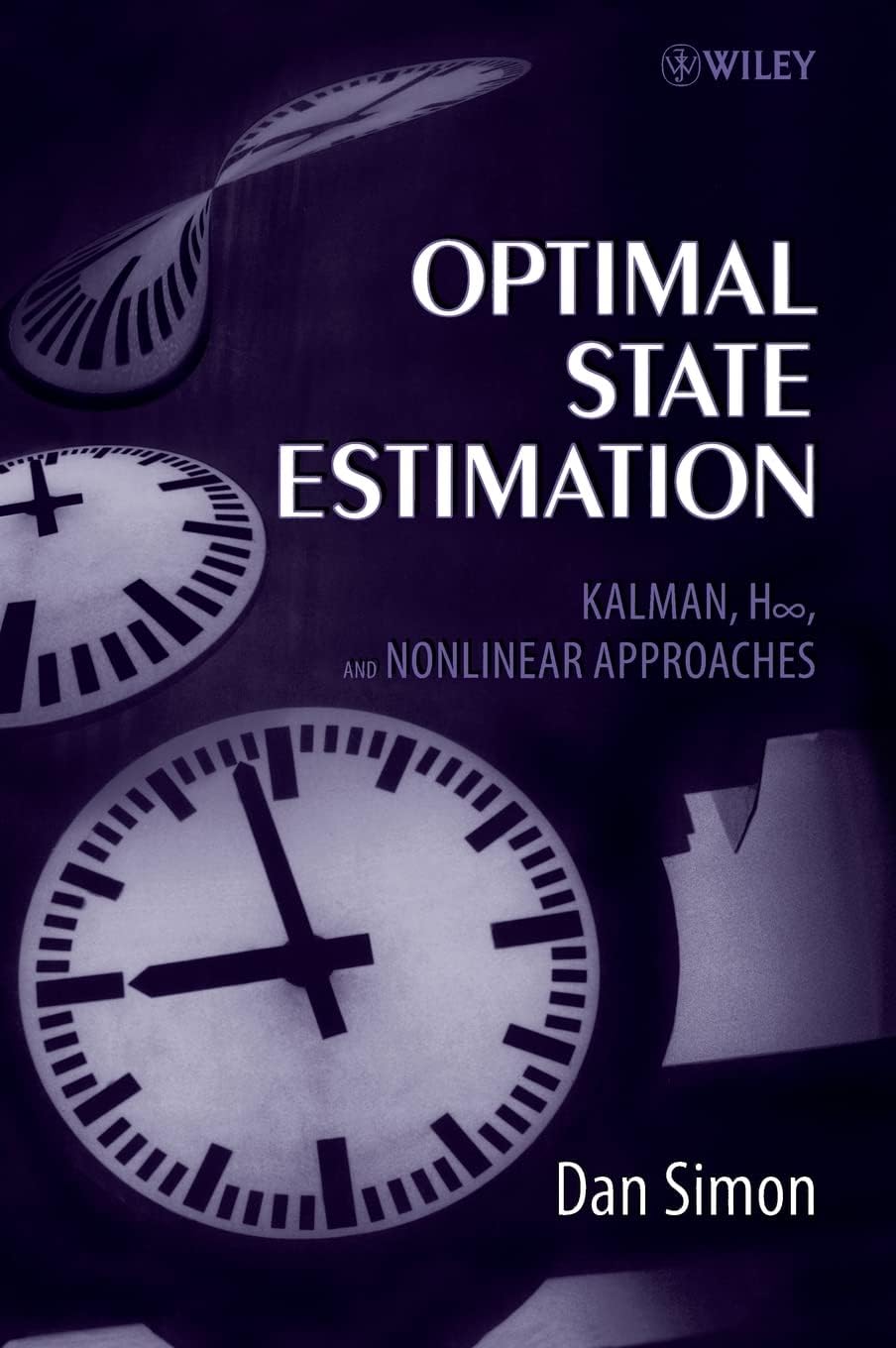
Optimal State Estimation: Kalman, H Infinity, and Nonlinear Approaches
Product ID: 14787300
💻MATLAB code for hands-on practice
📊Comprehensive state estimation methods
🧮Stepwise bottom-up learning
Desertcart purchases this item on your behalf and handles shipping, customs, and support to UK.
📈 Elevate your control systems game with the ultimate state estimation toolkit!
Optimal State Estimation offers a rigorous yet accessible guide to mastering Kalman, H Infinity, and nonlinear filtering techniques. Featuring a unique bottom-up pedagogical style, it combines clear theory, practical MATLAB code, and advanced topics to equip engineers, researchers, and students with the skills to confidently apply state estimation across diverse scientific and engineering fields.
| Best Sellers Rank | #472,053 in Books ( See Top 100 in Books ) #96 in Robotics (Books) #194 in Robotics & Automation (Books) #481 in Telecommunications & Sensors |
| Customer Reviews | 4.0 out of 5 stars 59 Reviews |
W**M
A very good book, written well for independent study
I am a researcher and my background is in estimation, prediction modeling, and inferential models/methods. I found this book easy to follow (partly because of my background) in writing style. The book is true to the title and focuses on Kalman filter from several different perspectives (properties, implementation, modifications, etc.) I am still reading the book, so far I have read ch.3, 5 and 15. I have found a very good comparison of Kalman filter derivation through RLSE route, and Bayesian way. A good comparison of both approaches. Author is also good in consistently providing the references through out the book, if you choose you can take a deeper dive along the references to sort out details that may be relevant to implementation and research. I must have to say, a prior applied background is necessary to really appreciate the contents of the book intuitively.
P**N
In-depth and accurate.
Very comprehensive book.
K**S
Good reference or self-study book
I've got a fairly extensive background in applications of estimation, but I needed to learn about some of the extensions of the theory, so I bought this primarily for Chapters 7 and 11-12. It's easy to read and follow with lots of the all-important math to fill in the steps. That already gives it a leg up on many of the other books. The price point is excellent. (It's at the low end of the spectrum for hardback text books.) The notation he uses is probably the most common in the field. I'm used to a slightly different notation (from orbital mechanics courses), but it's close enough that I can easily adapt. For those that are complaining about Appendix C -- don't read it if it bothers you....sheeezzzz.... How narrow minded do you have to be to complain about an author's commentary in an Appendix?? Get over it. FYI, a really good book that applies some of the estimation techniques to orbital problems is "Modern Orbit Determination: Second Edition" by William Wiesel. It's less than $20 in paperback through Amazon and it walks you through some practical applications. If you are studying orbital mechanics or orbit determination, buy this book and Wiesel's.
A**R
Many errors. Loses reader's trust in progression and uncertain jumps in logic.
Very unfortunate book. The discontinuous jumps in logic and equation developments are especially difficult because of the many errors, which cause the reader not to trust his progression at every stage. This is NOT a good text. A 2nd edition might be good if while correcting all the errors he also provides a smooth continuous progression of logic. You know a great teacher when you hear one. They inspire you with the story. But not in this book.
T**R
Excellent for a newcomer
This book relates control theory elegantly, to those with a scientific background, but not much control theory history. Dan uses well laid out algorithmic approaches, suitable for programming, and examples to explain the details and show the complexities in action. I especially like the non-linear filtering chapters, and the comparison s between the Kalman Filter and other approaches (Particle Filter, etc.) I have several estimation/control theory texts, and this is the one I carry around with me.
C**I
Great book with a mission
Great book. Clearly written with significant simplifications of derivations compared to the earlier Sage & Melsa book (1971). I view the unusual philosophical final chapter as an indicator for the devotion and care with which this book was written: a mission to help.
H**A
Optimal State Estimation-A review by Dr.Humayun Akhtar
I have gone through this entire book in detail. I think that it is a great blend of theory and practice based upon the author's teaching experience and practical experience. It is not difficult to read and understand provided you have some background in linear systems. It was very useful for me to catch up with most of the state-of-the art in this field. Since each author reflects his own expertise in his own book, I think it is not necessary to compare this to any other book on State Estimation as it stands out as a classic by itself. I recommend this book without any reservation and will use it to teach Optimal State Estimation and conduct research in this area. Dr.Humayun Akhtar [email protected]
D**I
Religion in a Mathematics textbook??
I got this book for review purposes, since I have been out of the practice for a while. Though the book jumps around a bit, and doesn't build the mathematical foundation that I was used to in graduate school, I would say that it might suffice as a reference but I wouldn't recommend it as the only text to use on the subject. I found the book, "Applied Optimal Estimation" to have the right mix of theory and application (Arthur Gelb). That book also builds itself up pretty well without going off on any tangents like Simon does. I can only give it two stars, instead of three, for the following reason: The most regrettable portion of this book was Appendix C, where optimal estimation is made analogous to finding the meaning of life (or finding truth about the big philosophical questions). I thought this might be a form of humor - but upon reading the appendix I found that it was actually an opportunity for the author to express his christian beliefs. At the very least, I think he should have left the conversation at his family dinner table where he probably hatched it - but now that pandora is out of the box I would like to speak about it. The funny thing is that he equates the idea of finding an optimal filter to finding the optimal "world view" (referring to answering the big questions with a his optimal belief). Every scientist will tell you that the only way to go about answering such questions, with something meaningfull as to shape our view of the world, is a practice where you can form a hypothesis and TEST it. Something you can't do with the big questions. The religious system you are asserting is an unobservable one Dr Simon!! With regard to the meaning of life, the only reasonable (and optimal) world view is: "I don't know" (and I am certain that Simon doesn't know either).
M**H
Getting started with kalman filtering the easy way
I was looking for a good introduction into kalman filtering and I'm really glad that my choice fell on "Optimal State Estimation" by Dan Simon. The step by step explanations result in a book that is very easy to read. To get an overview I've read the first 8 chapters in the last 3 days without giving to much attention to details. But still I think I have a good understanding of (linear) kalman filtering now. In "6.1 Sequential Kalman Filtering" I was pretty confused by the notation. It took me some time to figure the dimsions out. H_{ik} is introduced as the i-th row of H_k so I assumed that P^{+}_{i-1, k} is the i-1 -th row of P^{+}_k. But in fact P^{+}_{ik} is a matrix, K_{ik} and x^{+}_{ik} are col-vectors. In this edition (1st) there are some errors I've already spotted (although I've "binge read" the first 8 chapters). But all mistakes I found are already listed with a corrected version on the homepage of Dan Simon (well, to be exact on the webpage of the book). But still I think it's a great book for understanding and implementing kalman filter.
S**L
Great book, full with practical examples
I first bought this book to learn about the UKF, but was pleasantly surprised to find a multitude of well presented information about the other types of Kalman filters (that I thought I knew about!). Although the examples are excellent, covering a range of practical problems, I found that the accompanying Matlab code was rather hard to follow, as it had little or no comments. I wouldn't really recommend this book to any beginners with Kalman filter, but I must say for anybody with any experience, it is certainly an invaluable text.
M**.
Praxisleitfaden für Einsteiger und mehr
In diesem Buch werden Kalman-Filter mit zahlreichen Varianten (auch "nichtlineare Varianten"), H_unendlich und Partikelfilter motiviert, beschrieben und diskutiert. Des weiteren gibt es Rechenbeispiele und auch Übungsaufgaben. Die Rechenbeispiele sind oft sehr einfach gehalten (z.B. skalar), was zwar die Übersichtlichkeit fördert, jedoch gerade Fragen zum mehrdimensionalen ein wenig zu kurz geraten lässt. Vom mathematischen Standpunkt ist das Buch, soweit ich es einschätzen kann, im Wesentlichen korrekt, enthält an ein paar Stellen jedoch Ungenauigkeiten - so schreibt der Autor z.B., dass es zu jeder Matrix eine Zerlegung in Eigenvektoren gibt. Das Buch ist klar für die Praxis gedacht: Im Buch werden kontinuierliche und zeitdiskrete Systeme untersucht, jedoch wird aus den zeitkontinuierlichen Systemen fast immer ein zeitdiskretes System gemacht, so dass sich die Filter auf einem Digital-Computer direkt anwenden lassen. Fazit: Für Einsteiger und zum Nachschlagen für die Praxis empfehlenswert. Wer rigorose Beweise für jede Aussage sucht, könnte an ein paar Stellen enttäuscht werden.
Trustpilot
3 weeks ago
1 month ago