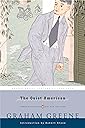
The Quiet American (Penguin Classics Deluxe Edition)
Product ID: 1234839
Desertcart purchases this item on your behalf and handles shipping, customs, and support to UK.
Graham Greene's classic exploration of love, innocence, and morality in Vietnam "I never knew a man who had better motives for all the trouble he caused," Graham Greene's narrator Fowler remarks of Alden Pyle, the eponymous "Quiet American" of what is perhaps the most controversial novel of his career. Pyle is the brash young idealist sent out by Washington on a mysterious mission to Saigon, where the French Army struggles against the Vietminh guerrillas. As young Pyle's well-intentioned policies blunder into bloodshed, Fowler, a seasoned and cynical British reporter, finds it impossible to stand safely aside as an observer. But Fowler's motives for intervening are suspect, both to the police and himself, for Pyle has stolen Fowler's beautiful Vietnamese mistress. Originally published in 1956 and twice adapted to film, The Quiet American remains a terrifiying and prescient portrait of innocence at large. This Graham Greene Centennial Edition includes a new introductory essay by Robert Stone. For more than seventy years, Penguin has been the leading publisher of classic literature in the English-speaking world. With more than 1,700 titles, Penguin Classics represents a global bookshelf of the best works throughout history and across genres and disciplines. Readers trust the series to provide authoritative texts enhanced by introductions and notes by distinguished scholars and contemporary authors, as well as up-to-date translations by award-winning translators. Review: A Fascinating Novel About 1950s Vietnam Authored by An Iconic British Author - "The Quiet American" is a really interesting and well written novel. It was authored in the 1950s. It is set in Vietnam in the 1950s during fighting that includes the French and predates official American military involvement. The author, Graham Greene is an iconic British author. The protagonist is a British Journalist. The story involves political intrigue, romance, and some adventure. It is not necessarily a fast pacd novel. It is a very well written story that allows for a lot of contemplation. In retrospect it looks like a warning to America about what the future in Vietnam holds. I took my time reading this novel and found it fascinating. This story is the type of novel that is not always a "light read". It is a thinking person's novel. There is some symbolism. I accessed a copy of Spark Notes on line for free and studied the novel as I read. I read chapters and then studied Spark Notes for that chapter. I am glad that I did so. It added to the experience. However the novel is comprehensible without the additional study. I really liked this novel and am quite glad that i read it. In case it matters I also listened on audiobook and read simultaneously. I am glad that I did both. There were times I re read certain episodes that seemed intellectually deep. This is the kind of novel I read when I have time to concentrate. It was both enjoyable and really worth the effort. Thank You... Review: The Quiet American by Graham Greene - This book gives a stark and unsparing on-the-ground view of Vietnam, or French Indochina as it was commonly referred to at the time, and early French and American involvement, in the early 1950s. The author was openly disdainful in real life of what he perceived as American crassness and naivete, which he proceeds to (sometimes blastingly, sometimes almost-sympathetically) portray in this story of Pyle, an idealistic young anti-communist American "diplomat", with devastating effect simply because Greene's contempt and rage are not without merit. Greene's belief that innocence is an evil in the world is disconcerting on a certain level, an idea worth struggling with. There is plenty of sometimes-lethal action, intrigue and an unflinching if subtly-couched look at the character flaws of the book's first-person British-journalist narrator, including but not limited to his reactions to Pyle's s stealing his Vietnamese girlfriend. The grim joke in the book's title is in the fact that Pyle dies in the beginning pages, making him a very quiet American indeed. The rest of the book is flash-back, detailing the intrigues, unique to that time and place and struggle and culture (including Pyle's callousness to the deaths of innocents in advance of his desire to impose "democracy" on another culture and country) that lead to his death. This book is a sobering learning experience, in view of the later American military involvement, whose denouement validated much of what this book has to say. Whether such a cynical view of the world is fully merited is a question for the individual reader to mull.
| Best Sellers Rank | #14,771 in Books ( See Top 100 in Books ) #127 in Classic American Literature #231 in Contemporary Literature & Fiction #285 in Espionage Thrillers (Books) |
| Customer Reviews | 4.4 out of 5 stars 9,644 Reviews |
F**Y
A Fascinating Novel About 1950s Vietnam Authored by An Iconic British Author
"The Quiet American" is a really interesting and well written novel. It was authored in the 1950s. It is set in Vietnam in the 1950s during fighting that includes the French and predates official American military involvement. The author, Graham Greene is an iconic British author. The protagonist is a British Journalist. The story involves political intrigue, romance, and some adventure. It is not necessarily a fast pacd novel. It is a very well written story that allows for a lot of contemplation. In retrospect it looks like a warning to America about what the future in Vietnam holds. I took my time reading this novel and found it fascinating. This story is the type of novel that is not always a "light read". It is a thinking person's novel. There is some symbolism. I accessed a copy of Spark Notes on line for free and studied the novel as I read. I read chapters and then studied Spark Notes for that chapter. I am glad that I did so. It added to the experience. However the novel is comprehensible without the additional study. I really liked this novel and am quite glad that i read it. In case it matters I also listened on audiobook and read simultaneously. I am glad that I did both. There were times I re read certain episodes that seemed intellectually deep. This is the kind of novel I read when I have time to concentrate. It was both enjoyable and really worth the effort. Thank You...
J**D
The Quiet American by Graham Greene
This book gives a stark and unsparing on-the-ground view of Vietnam, or French Indochina as it was commonly referred to at the time, and early French and American involvement, in the early 1950s. The author was openly disdainful in real life of what he perceived as American crassness and naivete, which he proceeds to (sometimes blastingly, sometimes almost-sympathetically) portray in this story of Pyle, an idealistic young anti-communist American "diplomat", with devastating effect simply because Greene's contempt and rage are not without merit. Greene's belief that innocence is an evil in the world is disconcerting on a certain level, an idea worth struggling with. There is plenty of sometimes-lethal action, intrigue and an unflinching if subtly-couched look at the character flaws of the book's first-person British-journalist narrator, including but not limited to his reactions to Pyle's s stealing his Vietnamese girlfriend. The grim joke in the book's title is in the fact that Pyle dies in the beginning pages, making him a very quiet American indeed. The rest of the book is flash-back, detailing the intrigues, unique to that time and place and struggle and culture (including Pyle's callousness to the deaths of innocents in advance of his desire to impose "democracy" on another culture and country) that lead to his death. This book is a sobering learning experience, in view of the later American military involvement, whose denouement validated much of what this book has to say. Whether such a cynical view of the world is fully merited is a question for the individual reader to mull.
G**O
It's Always 1955 in Greene Land !
Or perhaps it's that the 1950s lasted 30 years in England. It was plainly still 1955 in England when i spent some months there in 1979, and indeed I suspect that it was 1955 for Graham Greene from the end of World War 2 until the catastrophe of Margaret Thatcher. Greene wrote six books in the '50s or thereabouts: The Third Man (1949), The End of the Affair, Loser Takes All, The Quiet American, Our Man in Havana, and A Burnt-Out Case (1960). In none of them was the awkward Quietist Catholicism of his earlier novels sustained; instead both his 'novels' and his 'entertainments' became increasingly anti-colonial in content and critical of both Catholic and Anglo-American values. Throughout his long career, nonetheless, Greene was the most ineffably British of novelists, at least as we readers perceive him through his literary personae, in whom diffidence and arrogance are two faces of the same shilling. The 'narrator' of The Quiet American, the aging British journalist Thomas Fowler, on assignment in French Vietnam, is the epitome of that blend of diffidence and arrogance, the latter politely sheathed by the former. Fowler has a cosy live-in lover, Phuong, a moderate opium dependency, and no desire to return to the UK, to his bitter Anglican wife who refuses him a divorce. At a club with Phuong, he meets Alden Pyle, the "quiet American" of the title, a young, handsome Harvard-grad supposedly in Vietnam on a non-military mission. In fact, Pyle is an OSS agent provocateur, a liaison to the rogue general Trinh Minh The, whom Pyle's superiors perceive as an effective "Third Force" in the war between the French colonialists and the 'communist' Viet Minh. Fowler and Pyle become rivals for 'possession' of Phuong. And that's all I mean to reveal of the plot! This 'triangle of passion' is the skeleton of the novel, but it's Greene's depiction of Alden Pyle that sustains the exceptional interest of the book. Pyle is seemingly a naive idealist, innocent, brash, firmly convinced of the good intentions of his country, committed to the political philosophy of York Harding (an imaginary scholar). There are rumors that Pyle's persona was based on the real-life American Edward Lansdale, a CIA 'counter-insurgency expert' whose interventions in Vietnam, Cuba, and elsewhere qualify him as one of the colorful scoundrels of the 20th C. In any case, Pyle's idealism is of the sort that accommodates slaughter of innocents. To put it bluntly, he's a terrorist, but "our" terrorist. The gauze that separates "idealism" from ideological fanaticism is very thin in Pyle. But Graham Greene is not merely depicting one plausible malefactor -- one who can smile and smile and yet be a villain. Pyle is not only a 'quiet' American; he's an archetypal American, a synecdoche of America as Greene perceived it. "I never knew a man who had better motives for all the trouble he caused," Fowler says about Pyle; Greene is saying the same about America: "I never knew a People who had better motives for all the catastrophes they caused." Remember that Greene wrote this book before 1955, when it was published, and therefore before the French debacle at Dien Biên Phu. But it reveals what everybody except the American public knew: that America was waiting in the wings to take over the anti-communist crusade in 'Indochina'. Pyle describes explicitly to Fowler what later would be called the "Domino Theory". Pyle's utter inability to grasp the mentality of the Vietnamese would become exactly what led to the inability of Kennedy, Johnson, and Nixon to comprehend why America could only 'win' a war in Vietnam by "turning it into a parking lot". In effect, Graham Greene was the most prescient writer since Nostradamus! This little novel is such an accurate prophecy of the American calamity in Vietnam a decade later that, if it had been read carefully in Washington, it might have saved hundreds of thousands of lives.
S**S
A Prophecy Hidden As A Novel
One of the most amazing things that jumped out at me about Graham Greene's novel, "The Quiet American," was the copyright date. 1955. How many years BEFORE America found itself mired in the nightmare of the Vietnam War? Why didn't anyone in power or policy see the warning in this novel? I'm still reading through all the extra material but I feel confident enough about the book itself and what I have read that I can definitely give this book five stars (the novel is over a third of this book). Alden Pyle, Greene's "quiet American," clearly represents America in this cruel world. He's young, strong, sure of his beliefs and willing to act on his own convictions--but in this world of deceit and corruption, he doesn't have a chance. And quite a few people have said the same thing about America in Vietnam. Beyond the deeper meaning of the setting and story (more powerful since it was written BEFORE the USA got stuck in Nam), the characters really make for some fiction. Pyle, the clear-eyed Yank looking to do good in Indo-China, runs into the narrator Fowler, an opium-smoking old Brit journalist who's seen too much and forgot how to care about anything--except the Vietnamese woman who comes between them. At the end of the 1970s, "Apocalypse Now" got a lot of kudos for its dark humor ("I love the smell of napalm in the morning!") but Greene had written along those lines in the 1950s: Fowler rides along on a bomb run and, after a village is blown to bits, the pilot points out the beautiful sunset on a nearby river. Up to this point, my favorite Greene novel had been "The End of the Affair," but now it's "The Quiet American." I also want to see the Michael Caine movie they made a couple years back.
G**N
Fascinating, insightful, but cynical
This is a fascinating look at the intrigue of a place and time that few Americans know much about--Vietnam in the early 1950s, during its struggle for independence from the French, and long before the conflict that brought it to the attention of the American public. The book was also written long before that more famous conflict (1955), so many of the scenes will seem fantastically prescient to a modern American reader. Some of that angered me, as it mirrored the American experience in the Vietnam War so closely, that you realize our leaders in the 1960s had no excuse for not knowing what they were getting us into. The narrator is a cynical British journalist--a bit too cynical for my taste, though he has some amazing insights into human nature. The treatment of the eponymous American is a bit high-handed at times, though sometimes deserved, and sometimes not. There is a smug dismissal of American naivete and meddling that is in part justified in hindsight, and in part seems like unwarranted cultural condescension. It is a well-told story, and it brings out the complications and enigmas of post-WW2 southeast Asia very well. I gained useful insights into the later Vietnam War era, but in the end I was left vaguely unsatisfied.
D**R
A Powerful Novel About Taking a Stand
I went into my reading of The Quiet American blind. War never interested me until this past year, so I cared little for the details of war in Vietnam. As I started reading this, I thought I was reading about what Americans describe as the Vietnam War. Perhaps my blindness mirrors that of soldiers going to fight in a war not their own. On the surface, this is a novel about a love triangle. But it ends up saying a lot about war and morality. Fowler is the viewpoint character. He's an old and cynical British reporter. He cares for the Vietnamese girl Phuong because he fears being alone. Pyle is a naive, but not innocent, American, who wants to steal Phuong from Fowler. Unlike George Orwell - everything is political - Fowler thinks he can report on the war without taking sides. It's only when something violates a morality he didn't know he had, that he takes action. Greene gives a haunting, unromantic portrayal of the suffering of Vietnam at war. At first the war is only a backdrop; a sense of atmosphere. But bit by bit we see more and more until we're walking in blood, looking at twitching legless torsos. Written before America involved itself in the war, you can understand why it's seen as a prophetic critique. Something about the style of this book -- haunting, humid and exotic -- reminds me of Peter Carey's My Life as a Fake. If you like action-packed novels, you won't like this one. But if you like character-driven, intelligent books, read it.
D**T
Captivating
An English reporter in French-occupied Vietnam, involved with a beautiful Vietnamese woman in Saigon just prior to the American occupation meets a high-bred Bostonian. From there we discover the different viewpoints and irrational rationalizations about the war, the different factions involved and the complex love triangle of the three main characters. Brilliantly written and presciently lays out in detail why the future involvement of America in this war was destined to fail at a huge human cost.
D**H
"No one has had better motives for all the trouble he caused"
Published in 1955, this book by acclaimed author Graham Greene is remarkably prescient. In this account, a jaded British newspaperman has spent years covering the resistance to French colonization in Vietnam. While he has a wife back in England, he has been in a long term relationship with a local Vietnamese woman for years. Then one day a seemingly bright though innocent American shows up, saying he's there to help the Vietnamese people. It soon becomes clear that though this American Pyle had presented himself as a humanitarian, in actuality, he is with American intelligence (it's unclear if the initials CIA were well known in 1955 as they are today; they are never mentioned here). The journalist, Fowler, comes across evidence that Pyle is equipping Vietnamese rebels with material to construct bombs. Fowler confronts him about this, and Pyle's true feelings about the people he is there to "help" become clear. He sees them as children who need the helping hand of the white man to make sure they don't go down wayward paths, for example, by choosing Communism. Things eventually come to a head in dramatic fashion, and one can see how many already thought that Western meddling in these locals was a path to hell. This book is justifiably a classic, and the trope about the "Quiet American" who arrives with the best of intentions and little else is brilliantly introduced by Greene in this book. This book will appeal to fans of classic literature, the Cold War era, or traditional spy fiction.
W**M
Brilliant
Good sense of humour. The book transports you back in time to the 1950s Saigon under French control. He writes about things that give you clues of what really happened there.
N**A
will buy again
as described great quality and service
G**!
QUIETLY STUNNING...
This book is quietly stunning. Littered with glimpses and literary visions of beauty and thoughts of powerful effect, this work of written art will move and entertain the reader in ways unseen for generations. By the end of chapter one, we learn that the American in question (Mr Pyle) is found dead with mud in his lungs under the bridge to Dakow. The one true friend of the deceased - who is also the tale's narrator - is questioned by the local police who speak in an almost incomprehensible combination of French / Vietnamese. He is soon released after identifying the body but even that scene, despite its macabre overtones was hugely entertaining and had strong elements of suspense. Pyle's local girlfriend is compelling in her silence. I look forward to learning more of her (as do the local police, I imagine). So, is the book a whodunit, then? You will have to read it yourself to find out. But is certainly a classic. It is a book for the ages. It is populated by truth, love, vulgarity and brings home the horrors of war and the effect it has on the human condition. I was going to borrow this book from my local library. I weakened at the last minute and purchased it for my e-reader. It has turned out to be the best eleven dollars I have spent for ages. Graham Greene was a genius and has demonstrated his full understanding of what it means to be human. BFN Greggorio!
ジ**田
英文学の魅力
早川書房から翻訳が出ていますが、原文を(Kindleの力を借りて)読むほうがはるかに堪能できます。単なるアメリカ批判でなく英国の病いも織り込み、深みのある重層的な構造を持った物語になっています。この主人公を「おれ」と訳すのはどうでしょう。「私」としたほうがグリーンの文体に忠実なように思われます。東南アジアの戦乱と、深く入り込んだ欧米との抜き差しならない関係を背景に、ぬぐいきれない白人の病理も、アジア理解の限界も、様々含めての秀作と評価します。
P**N
Understatement
This book has the flavor of slow cooking. Immensely readable and page turningly good. Greene is the master of the understatement and has a gift for observation leaving the enthralled reader comment after savorful comment. The book, unintentionally, helps make sense of geo politics in the modern age. The more things change the more they remain the same.
Trustpilot
1 month ago
4 days ago