Buy anything from 5,000+ international stores. One checkout price. No surprise fees. Join 2M+ shoppers on Desertcart.
Desertcart purchases this item on your behalf and handles shipping, customs, and support to UK.
🍶 Double the jars, double the delight—upgrade your yogurt game today!
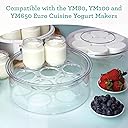
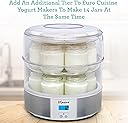
The Euro Cuisine GY4 Expansion Tray is a BPA-free, dishwasher-safe accessory that doubles the capacity of compatible Euro Cuisine yogurt makers (YM80, YM100, YM650) from 7 to 14 jars. Designed for seamless integration, it allows users to create larger batches or multiple flavors simultaneously, making it ideal for families and yogurt enthusiasts seeking convenience and variety.


| ASIN | B003V2J0NM |
| Additional Features | Electric Stovetop Compatible |
| Best Sellers Rank | #374,796 in Kitchen & Dining ( See Top 100 in Kitchen & Dining ) #90 in Yogurt Makers |
| Brand | Euro Cuisine |
| Brand Name | Euro Cuisine |
| Capacity | 42 Fluid Ounces |
| Color | Clear |
| Customer Reviews | 4.4 out of 5 stars 391 Reviews |
| Global Trade Identification Number | 00737770000045 |
| Included Components | Expansion Tray |
| Item Dimensions W x H | 9.75"W x 3.5"H |
| Item Type Name | Yogurt Maker Accessory |
| Item Weight | 13.6 ounces |
| Manufacturer | Euro-Cuisine, Inc |
| Manufacturer Part Number | GY4 |
| Material | Plastic, Silicone |
| Material Type | Plastic, Silicone |
| Model Name | GY4 |
| Model Number | GY4 |
| Product Dimensions | 9.75"W x 3.5"H |
| Shape | Round |
| Special Feature | Electric Stovetop Compatible |
| UPC | 737770000045 |
| Unit Count | 1.0 Count |
| With Lid | Yes |
G**A
Double your jars of yogurt, with only 2 extra hours.
It came fast and worked great! I was able to make 14 jars of yogurt and that’s exactly what I wanted! I added the 2 hours to my yogurt time, so my 24-hour yogurt became 26-hour yogurt! That’s all I did differently. And it was easy. I did (and do) have to make sure that the yogurt maker stays on for 26 hours constantly.
G**N
PERFECT Addition to Your Euro Cuisine Yogurt Maker
Update: I have been using this for several months now. . .and one VERY important thing to note: You really need to rotate the jars half-way through. Put the bottom on the top. . . and the top on the bottom. Otherwise your top jars may not "set". It's warmer on the bottom than the top. . .but by rotating the yogurt turns out fine. ~~~~~~~~~~~~~~~~~~~~~~~~~~~~~~~~~~~~~~~~~~~~~~~~~~~~~~~~ What a GREAT addition to my Euro Cuisine yogurt maker! Great quality. Reasonable price. It fits snugly. It's just great. Make sure you use authentic Euro Cuisine jars, which fit perfectly. Though you can find less-expensive jars on Amazon, I recommend the ones listed below. I purchased from seller "stores123". They are "authentic" Euro Cuisine jars with the "date lids". Euro Cuisine Set of 8 Glass Jars for Yogurt Maker GY2640
J**.
Doubled my yogurt production! Some tricks to make it work well
This actually works really well and I am able to double my yogurt production. There are a few tricks though. First of all I use it with the Euro Cuisine YM80. I use a combination of the jars that come with the yogurt maker and Kamoto jars I purchased off Amazon. As a side note, the non-Euro Cuisine jars work great. You should know though that the Kamoto jars do not fit in the holes on the second level of the yogurt maker but, instead, sit on top of the holes. Not a problem for me though. I followed the advice of the other users and switched the yogurts to the other level mid way. When I took the temperatures of the first and second level the second level is about 20-25 degrees Fahrenheit lower (That's why the recommendations are for you to run it for a couple hours longer). By the 5 hour mark the second level is definitely firming up, however, at a much slower rate than the first level. When I took the temperatures on the first level the outer jars were around 113-118 degrees F and the middle jar was 129 degrees F. The upper level jars were consistently around 91-92 degrees F. I tried it with and without insulating the top level with towels or tea cosies, and for me, there was no difference temperature wise. Another thing to know, but that is not a problem for me, is the lid of the yogurt maker dips in the middle and the condensation likes to move there, so I just take the lid off occasionally and shake out the water. This second level has made life much easier and can now make a weeks worth of yogurt at a time. I would definitely recommend it if you find yourself making yogurt more often than you'd like and would like to double your production.
R**.
Second tier works great!
I've been making yogurt every week for four years with the Euro Cuisine YMX650 Yogurt Maker. Each batch turns out firm and smooth, with no whey (liquid) in the jars. I find that the second tier provides a time-saving way to make two batches quickly. Because there have been quite a few reviewers who experienced difficulty with the second tier - I thought I'd post my process. I hope this helps, and good luck with your yogurt. * I use 49 ounces of whole milk with 2 TABLESPOONS of plain Greek yogurt as a starter for each 7-jar batch of yogurt. * To prepare the mix for the yogurt maker; USING A COOKING THERMOMETER, I gently heat the milk to 182° f for 2-3 minutes stirring periodically. I then cool the pot of milk to 104°-105° f. Next I mix 1/4 cup of the cooled milk into the yogurt in a separate bowl to temper it, then gently stir that mixture into the rest of the milk and skim off any foam that develops. Finally, I pour the milk/yogurt mixture into the jars and wipe off any drips. * When processing a single 7-jar batch - I put the jars into the COLD yogurt maker and let them process for 6-hours. Since the yogurt maker heats to a steady 120° f, more time than that causes the whey to separate from the curd and leaves the yogurt cracked and watery. * When processing both tiers (14-jars) - I PREHEAT the yogurt maker, put a warm towel on top then cover the towel and the outside of the top tier (only) with a soft insulated "cooler" bag to keep the heat in. The top layer is slightly cooler than the bottom at about 114° f. Because I can't make all the jars at once, I put the first batch of jars in the TOP layer. I re-warm the towel and replace the "cooler" bag on top while I work on the rest of the jars. (It takes me about 10-minutes to get the second batch mixed and in the jars) I put these jars on the bottom layer, check that the towel is still warm and the cooler bag properly in place. After processing 3 1/2 hours, I switch the jars from top to bottom, re-heat the towel and replace the "cooler" bag on the top tier of the yogurt maker. I then process the yogurt for an additional 3 1/2 hours. A total of 7-hours. For me, using this method, the yogurt from both tiers comes out firm and creamy.
R**L
Works but top level sets softer.
Works to double yogurt production. Instructions say add 2 hour’s incubation time, but that didn’t seem long enough. Bottom level yogurt came out firm, but top level with the expansion tray was much softer. The bottom sets directly on the heat, it takes much longer for the top rack to set. No difference in anything other than the firmness.
A**T
This is a wonderful and essential addition to the yogurt maker
This is a wonderful and essential addition to the yogurt maker. I put 8 oz jelly jars in the bottom and the jars that come with it in the top. I place a wet washcloth in the bottom to disperse the heat and place a bathmat over the machine to keep it all nice and warm because there is a slight gap when you use the jelly jars in the bottom because they are too tall. This does NOT affect performance and I did NOT have to switch the top and bottom jars half way through if I use the washcloth and bathmat as described. I buy yogurt about once every three months as new culture and just use my left over each time until it starts to get 'runny". My recipe is this: I use fresh warm milk from our cow ( I do not heat then cool it), I add 1/2 cup of store bought greek yogurt or one 6 oz jar of my own to a glass pyrex four cup pouring pitcher, then put in a little milk and whisk to disperse the yogurt. I then add three cups of milk and whisk again. It then pours easily into the jars and I fill as many as I want to make (LEAVE THEM UNCOVERED) and put the machine together as I fill them and cover it all with a bathmat. This is a wonderful machine and I love the top tier which allows me to make a lot of yogurt at once - saving me time. It is very rugged not cheap plastic. You will be VERY HAPPY with this addition if you purchase the yogurt maker.
T**M
Great idea but it doesn't work
I purchased this because I go through a lot of yoghurt. I have tried everything to get the top layer to be successful but only the bottom layer works. I have tried covering it with a towel thinking it wasn't getting to or staying at the correct temperature, but this didn't work. I have tried different incubation times and sizes of containers without success. This was a bummer purchase and a waste of money.
M**X
Top tier doesn't set as well
I've tried making 2 layers twice. I followed the instructions and added 2 hours to the time. Still, the top layer was of a drinking yogurt consistency, and the bottom layer was not as solid as one is used to. I have made yogurt for years in Europe. First in a utility room where the ambient temperature was sufficiently high. I just left all my jars overnight and they were nicely set the next morning. Then later I got a 6 small jar-electric yogurt maker and left the jars there for 14 hours. Also OK. I never boiled the milk using mostly 2% long-life milk. Full cream milk and fresh milk also worked but the cream settles on top. I warmed the milk in a saucepan until it was tepid. I stuck my finger into the warming milk and when I couldn't feel my finger, then it was ready to be poured into the jars into which I previously had poured some yogurt starter. I never bought any special starter using any plain yogurt mixed with some of the warmed milk. After 8 hours, I had expected to see moisture on the top plastic lid of the second tier. I noticed this moisture (condensation as mentioned by the manufacturer) when using only one level. But there was no condensation! As mentioned, the top layer was much less set than the lower level after 8 hours. After reading all the 2 tier issues related to the temperature of the top layer, loss of heat from the top layer, and transmission of heat from the heating element, I decided to try using only 12 glasses for 10 hours leaving out the middle ones, figuring that the heat could better climb up to the top jars. The result was even worse than with 14 jars. I used 2% Aldi milk and I didn't measure the milk temperature. But the ambient temperature of the kitchen was much lower on the second try. (Cold winter spell had hit). So after further reading, I decided next (3rd) time to use my fever measuring thermometer (don't have a kitchen one) and heat the milk to 105°F (40°C), and cover the entire two-tier unit with the box made from the yogurt maker packaging (see photo). I'll still leave the 14 jars for 10 hours using 2% milk and add an update. There must be a way to get all the factors just right. UPDATE: I tried again using 2% Aldi milk heated to finger warm as I had no suitable thermometer. The starter yogurt was a mixture of my own homemade and fresh Dannon full-fat yogurt (about 8oz for the 14 glasses). I placed two clear shower caps over the top lid and then the box in the picture. I set the whole thing to 10 hours. After 10 hours I switched off the current but left the box for another hour. The bottom 7 glasses were much warmer than the top 7. The top yogurt was still less set than the bottom. After leaving everything in the fridge overnight I tasted both. More tart than when using less time. All were still drinking yogurt consistency with the top glasses being more fluid than the bottom glasses. I have decided to return the top accessory plus the 8 extra glasses which together cost about $30 as the results are not satisfactory. I saw the same new yogurt maker for $10,50 at a Salvation Army resale place. I have been told by my electrical engineer husband that the amount of current using two machines both running for less time (6 -8 hours) is insignificant.
Trustpilot
4 days ago
1 month ago